

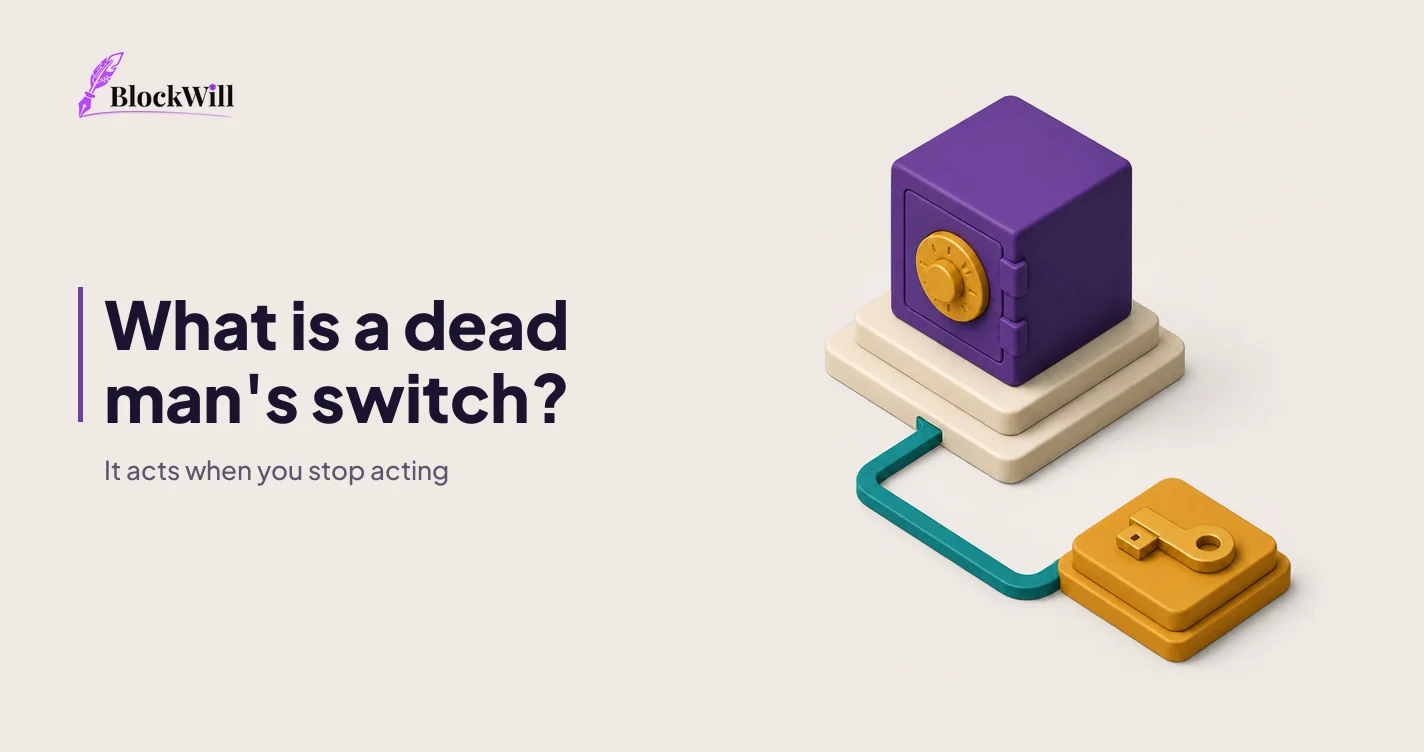
What is a dead man's switch?
A dead man's switch is a control that must be held, pressed or refreshed by a person to keep a system running. When the person lets go, the system assumes they are incapacitated and takes a pre-decided action. The name comes from railways: the driver keeps a pedal or handle pressed, and if it is released the brakes apply. The same idea runs the operator presence bar on a lawnmower, the clip-on safety key of a treadmill and the kill cord on a jet ski.
The important feature is the direction of the logic. Most controls do something when you act. A dead man's switch does something when you stop acting. That inversion is what makes it useful for inheritance, because death and incapacity are precisely the situations in which you cannot act, and it is also why every version of it has the same blind spot: it cannot tell the difference between "gone" and "busy".
Dead man's switch meaning in software
In software the physical pedal becomes a check-in. You confirm you are present at an interval, by replying to an email, signing in, tapping a notification or sending a transaction. If the interval passes without a check-in, the switch fires and performs the action you configured in advance. Common actions are sending a message, sharing or deleting files, publishing a document, or transferring an asset.
The phrase is also used for a journalist's insurance policy, where a cache of documents is released if the author is silenced. That is the same mechanism with a different payload. In this guide the payload is your estate: accounts, documents, keys and instructions.
How a digital dead man's switch works
Every digital dead man's switch, from a hobby script to a regulated platform, has the same four parts. Looking at a product through these four parts is the quickest way to judge whether it is safe to rely on.
- The heartbeat. How you prove you are still here. An email reply, a login, a tap, a signed transaction. The heartbeat should be easy for you and hard for anyone else to fake or to accidentally skip.
- The interval and grace period. How long the switch waits before it treats silence as absence, and how many reminders it sends first. Thirty days with three reminders behaves very differently from six months with one.
- The trigger and any cooldown. What happens when the interval expires. The best designs do not act immediately. They open a waiting period in which the owner or a named person can cancel.
- The payload and the recipient. What is released, to whom, and how the recipient proves who they are. This is where most products are weakest: a plain-text email to an address you typed years ago is a single point of failure.
Two consumer products built on check-ins are compared with BlockWill in BlockWill vs Eternal Vault and BlockWill vs DGLegacy.
The dead man's switches you may already have
You probably already own several dead man's switches without thinking of them that way. The table compares the common types on the four parts above.
| Option | Trigger | Cooldown or veto | What it releases | Weak point |
|---|---|---|---|---|
| Email switch (for example DeadMansSwitch.net) | You stop replying to check-in emails | Grace reminders only; no veto once sent | Pre-written emails and attachments | Secrets travel in plain text; one missed inbox ends it |
| Google Inactive Account Manager | 3 to 18 months without signing in | None after the period passes | Selected Google data to up to 10 contacts, optional deletion | Google services only; no instructions or authority |
| Password-manager emergency access (Bitwarden, LastPass) | A trusted contact requests access | Waiting period you set; you can reject the request | Your password vault | Logins only; nothing about property, documents or wishes |
| Smart-contract switch on a blockchain | You stop sending a heartbeat transaction | Usually none; code executes | Tokens or an encrypted payload to an address | Key handling, contract bugs and chain changes are on you |
| BlockWill VaultRelay | Executor confirmation, inactivity timer, or a date you set | Beneficiary cooldown; any executor can cancel | Encrypted vault to a verified beneficiary who already holds the key | Needs a real Ceremony and named executors; it is a plan, not a toggle |
Google Inactive Account Manager
Google's Inactive Account Manager is the most widely available dead man's switch. You choose an inactivity period of 3 to 18 months, up to 10 contacts, and the data each contact may receive (Gmail, Drive, Photos and so on). Google warns you by email and SMS before the period expires. You can also tell Google to delete the account afterwards. It is worth setting up today, with two limits in mind: it covers only Google services, and under RUFADAA its instructions can override what your will says about those accounts, so the two must agree. The guide to Google, Apple and Facebook accounts after death covers the equivalent settings on each platform.
Email timer services
Services such as DeadMansSwitch.net email you at a set interval and, if you stop replying, send your pre-written messages and attachments to the recipients you listed. They are simple and cheap, and that simplicity is the problem for an estate. Whatever you attach travels in plain text to an inbox that may have changed hands, and there is no way to confirm the right person opened it. Use them for messages, not for secrets.
Password-manager emergency access
Bitwarden, LastPass and similar tools offer emergency access: a trusted contact requests entry, a waiting period you set begins, and if you do not reject the request in time they receive your vault. This is a dead man's switch with a veto, which is the right shape. Its scope is the limit. A password vault holds logins, not property records, instructions, a seed phrase you kept offline, or the context your family needs to act.
Smart-contract switches
On Ethereum and similar chains a contract can hold assets and release them to an address if the owner stops sending a periodic "I am alive" transaction. Protocols have been built on this pattern for both tokens and encrypted files. The appeal is that no company sits in the middle. The cost is that you are now the company: you must keep the heartbeat going for decades, trust the contract code, handle the recipient's key management, and accept that a bug or a chain change cannot be appealed to anyone. The crypto inheritance guide goes through the alternatives for self-custodied assets.
Where dead man's switches fail
Three failure modes account for almost every horror story about dead man's switches, and none of them is exotic.
- False triggers. A six-week hospital stay, a phone left in a taxi, a reminder caught by a spam filter. The switch fires, the payload goes out, and nothing can recall it. If the payload was a seed phrase or a password, the damage is permanent even if you recover fully.
- Secrets in plain text. Most simple switches store the payload readable on the provider's servers and deliver it readable by email. That means the provider, an attacker who breaches it, and anyone with later access to the recipient's inbox can read everything. A switch that can read what it is holding is not a safe place for keys.
- The service dies first. A dead man's switch only works if the company running it outlives you. Small services shut down, and your switch disappears with them, usually without the recipients ever knowing they were named.
A fourth problem is less dramatic but more common: the switch delivers access without context. A sister who receives an email with forty logins and no explanation does not have an inheritance plan. She has a list, a grieving family, and no idea which items matter. The guide to preventing inheritance disputes shows how often that gap turns into conflict.
What a dead man's switch needs for an estate
The failures above point to a short list of design requirements. A dead man's switch is fit to carry an estate when it has all four.
- Two independent signals. Silence alone should not be enough. Pair the inactivity timer with a human confirmation, so that an executor is asked to check on you before anything proceeds, and a human claim is checked against your own activity.
- A cooldown with a veto. After the trigger, a fixed waiting period during which you, or a named executor, can cancel. This single feature neutralises nearly every false trigger.
- Key separate from data. The recipient should already hold the means to decrypt, handed over while you are alive, and the switch should deliver only encrypted data it cannot read itself. Then a breach of the service, or a premature release, exposes nothing on its own.
- Verified recipients. The person who receives the payload should prove who they are at the time of release, not merely own an email address you typed years earlier.
How BlockWill's VaultRelay implements it
VaultRelay is the release engine in BlockWill, and it is built as the kind of dead man's switch described above rather than a single timer. The owner chooses one or more triggers, every trigger is followed by a cooldown, and release goes only to a beneficiary who can prove identity and who already holds a physical key.
- Three triggers. An executor confirmation, an inactivity timer that asks your executors to check on you when you go quiet, and a dead man's switch set to a date you pick. In the walkthrough example an owner sets a 180-day inactivity timer alongside the dated switch.
- Beneficiary cooldown. After any trigger, a waiting period (14 days in the walkthrough) begins. Nothing is released during it, and you or any executor can cancel. A trigger fired by mistake, or in bad faith, stops here.
- Key handed over in person. During the BlockWill Ceremony you give your beneficiary a YubiKey or a BlockWill Secret while you are alive. On its own it opens nothing. The vault stays encrypted in your chosen data region.
- Verified release. When the cooldown ends, the beneficiary verifies who they are and receives the encrypted vault you set aside for them, which decrypts on their own device with the key they already hold. BlockWill never held the key, and the beneficiary never had the data early.
The nine-step walkthrough shows each of these settings on screen, and the live demo lets you run a trigger and a cooldown yourself.
Setting one up: a checklist
Whichever tools you use, the same steps apply. Work through them once and then review yearly.
- Turn on the platform switches you already have. Google Inactive Account Manager, Apple Legacy Contact, Facebook memorialisation settings and password-manager emergency access. Pick the same people in each.
- Choose an interval you will actually meet. Shorter intervals catch problems sooner but trigger falsely more often. For most people 90 to 180 days with reminders is a reasonable range; 30 days is for people who check in daily.
- Name executors, not only recipients. At least one person should be able to confirm, and to cancel. Tell them they hold that role.
- Never put secrets in the payload. Seed phrases, passwords and recovery codes belong in an encrypted vault whose key is handed over separately, not in an email that fires on a timer.
- Make the settings agree with your will. Under RUFADAA a provider's online tool ranks above your will for that account. The state-by-state RUFADAA guide explains the hierarchy.
- Rehearse. Trigger a test release with your executor and beneficiary present, confirm the cooldown works, then cancel. A switch nobody has ever seen fire is a switch nobody trusts.
Frequently asked questions.
What is a dead man's switch in simple terms?
A dead man's switch is a safety mechanism that acts when a person stops doing something, rather than when they do something. On a train, releasing the pedal stops the engine. In software, failing to check in by a deadline sends a message, releases a file or triggers a transaction. The switch assumes that silence means the operator is gone.
How does a digital dead man's switch work?
You set a check-in interval, say 30 days. The service emails or notifies you before the deadline. If you respond, the timer resets. If you do not respond after the interval and usually one or more grace reminders, the service carries out the action you configured: sending pre-written emails, sharing files, or signing a blockchain transaction.
Is Google's Inactive Account Manager a dead man's switch?
Yes, in a limited form. Inactive Account Manager lets you choose a period of inactivity between 3 and 18 months. When it passes, Google can notify up to 10 contacts, share the data categories you selected, and optionally delete the account. It covers only Google services, and the people it notifies receive data, not instructions or legal authority.
Can I use a dead man's switch for crypto?
You can, but the simple versions are dangerous. Emailing a seed phrase when a timer expires puts the phrase in plain text in someone's inbox. Smart-contract switches depend on you sending a regular transaction and on the contract never being upgraded or drained. A safer design hands the key to a person in advance, keeps the encrypted data separate, and releases the data only after a waiting period that an executor can cancel.
What happens if a dead man's switch fires by mistake?
That depends entirely on the design. A basic email switch sends everything at once and cannot be recalled. A better design adds a cooldown, a fixed waiting period after the trigger during which you or a named executor can cancel. BlockWill's VaultRelay, for example, places a beneficiary cooldown after every trigger and lets any executor stop a release during it.
What is the best dead man's switch app for estate planning?
There is no single best app, because the tools solve different problems. Google Inactive Account Manager handles one Google account. Email-based services handle messages. Password-manager emergency access handles logins. For an estate, look for a tool that separates the key from the data, verifies the recipient, supports more than one trigger, and includes a cooldown with a veto. Those four features are what turn a dead man's switch into an inheritance plan.
A Dead Man's Switch With a Veto, a Key and a Verified Recipient
VaultRelay pairs an inactivity timer, an executor trigger and a dated switch with a beneficiary cooldown any executor can cancel. The key is handed over in the BlockWill Ceremony while you are alive, and the encrypted vault is released only to a person who proves who they are. Run a trigger and a cooldown in the demo.
Keep reading.
This article is for general information only and is not legal, tax, or financial advice. Estate and inheritance laws change and vary by jurisdiction and personal circumstances. Always consult a licensed attorney or advisor in the relevant jurisdiction before acting. Case studies marked as illustrative are composite scenarios, not real client records.