
Client-Side Encryption: Why BlockWill's Servers Never See Your Will
Imagine you have a diary. Inside that diary is the most important secret you own. It says who gets your savings when you are gone. It says who looks after your kids. It tells your family where your money is hidden, what passwords unlock your phone, and which bank account holds your life savings.
Now imagine someone offers to keep this diary safe for you. They say, "Give it to us. We have a big building with cameras and guards. Your diary will be safer with us."
That sounds nice. Until you stop and think about it. The people in that building can open the diary any time they want. Their workers can peek inside. If a thief breaks in, the thief can read it too. If the police walk in with a paper from a judge, the company has to hand it over.
This is how most apps work. They take your secret. They promise to keep it safe. But they always have the key.
BlockWill works in a totally different way. We never see your will. Not once. Not ever. Not even if we wanted to.
This is called client-side encryption, and it changes everything.
The Big Idea in One Sentence
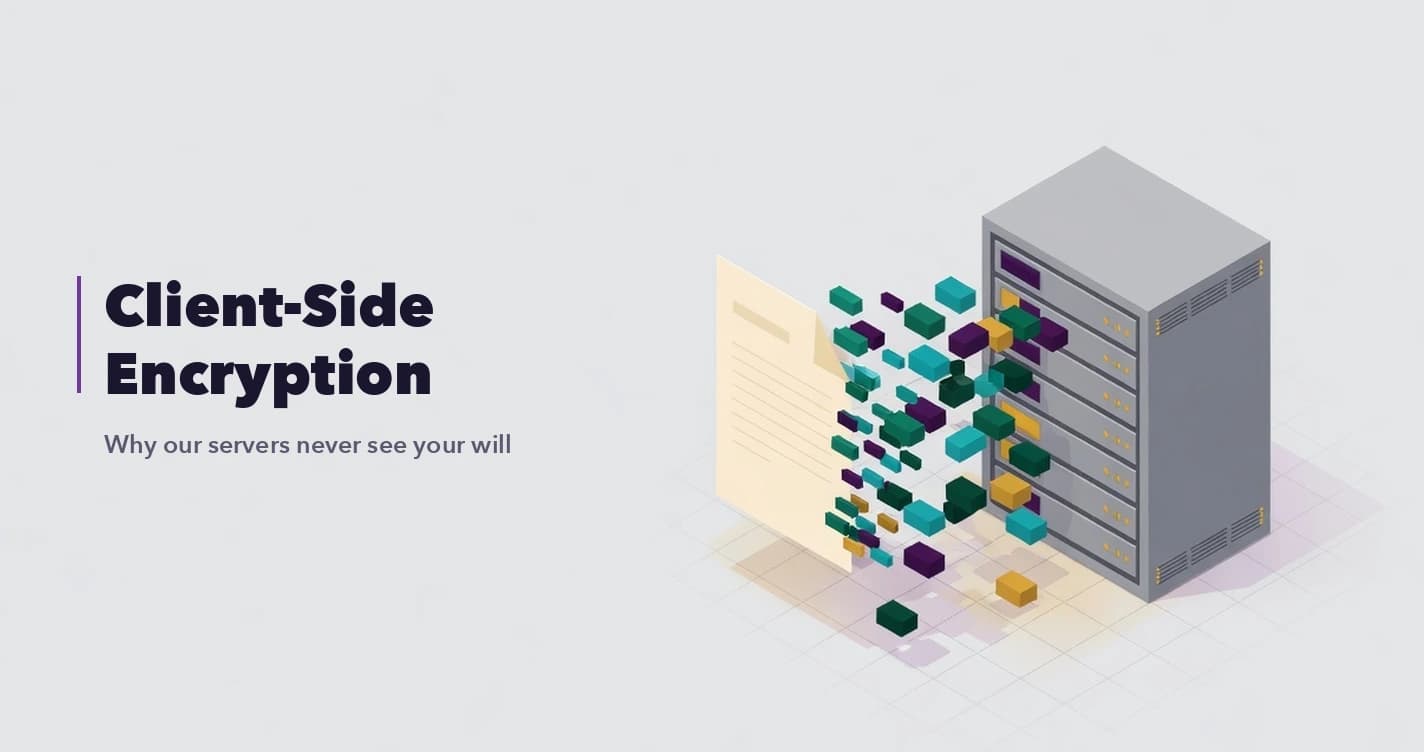
We build the lock on your device, so your will is already locked before it ever leaves your phone.
That is the whole trick. The lock is built on your phone. The key stays on your phone. By the time your will travels through the internet to our servers, it has already been turned into a pile of nonsense that nobody can read. Not us. Not hackers. Not anyone.
If you opened up our servers and looked at your will, you would see something like this:
9f3a7b21c8e0d4f6a2c91b8e7f3d5a0c2b9e8a7d6f5c4b3a2918073645f2e1d0
That is what your will looks like to the world. A long line of random letters and numbers that means absolutely nothing without your key. And your key never touches our servers.
How Most Apps Get This Wrong
Most apps say things like "your data is encrypted" and "we use bank-level security." That sounds good. But there is a sneaky problem hiding inside those words.
There are two main ways an app can lock up your stuff.
Server-side encryption means the app locks your data on their computer. They keep the lock. They keep the key. They control everything. If you ask them to show you your data, they unlock it and show you. If a hacker breaks in, the hacker can also unlock it, because the key is sitting right there. If a court tells the company to hand over your stuff, the company can. They have the key, after all.
Client-side encryption means the lock is built on your own device. Your phone or computer creates the key. Your phone or computer does the locking. By the time your data travels to the company's servers, it is already locked tight. The company never sees the key. They only store the locked-up nonsense.
Most apps use server-side encryption. They have to. It makes their lives easier. They can search your data. They can show you ads based on your data. They can recover it if you forget your password. They can hand it over if a government asks.
BlockWill uses client-side encryption. We made this choice on purpose. Because some things are too important to trust to anyone. Even us.
Why Your Will Is Different
A will is not like a photo of your dog. A will is not like a chat message about pizza. A will is the most personal, most private thing you will ever write down.
Your will lists every dollar you own. It names the people you love. It might say which child gets more help, or which family member you do not trust. It contains your bank passwords, your crypto keys, the location of important papers, and the truth about who matters most to you.
If anyone reads this without your permission, the damage is huge. Family fights start. Money gets stolen. Plans get changed. Identities get faked. The whole point of a will is that it stays locked until the moment it is supposed to open.
That is why your will needs the strongest kind of lock that exists. Not a "trust us" lock. Not a "we have good guards" lock. A lock that nobody, including the company that built it, can ever open.
The Hacker Problem (Breach-Proof)
Big companies get hacked all the time. You see it in the news every few months. Big bank, hacked. Big email service, hacked. Big password manager, hacked. Big healthcare company, hacked.
When hackers break into a company, they grab everything they can find. If the company stores your secrets unlocked, the hackers walk away with your secrets. If the company stores your secrets locked but keeps the key in the same place, the hackers grab the key too. It is like hiding a treasure chest and then taping the key to the lid.
This is what makes most data breaches so scary. The companies were not lying when they said your data was encrypted. The data really was locked. The problem is that the keys were sitting on the same servers, ready to be stolen.
With client-side encryption, this problem disappears. If hackers break into BlockWill tomorrow, they get a giant pile of locked nonsense. There are no keys to steal because the keys never lived on our servers in the first place. The keys are on your phone, where they belong.
This is what people mean by breach-proof. It does not mean nobody can ever attack our servers. It means that even if they do, they walk away empty handed. Locked nonsense is worth nothing to a hacker. Without your key, they cannot turn it back into a will. They cannot read it. They cannot sell it. They cannot use it.
This is the difference between a bank that puts your money in a vault and a bank that puts a giant question mark in a vault. A hacker can break into both. Only one of them gets a payoff.
The Court Problem (Subpoena-Proof)
There is another scary scenario most people never think about. What happens if a court asks the company to hand over your will?
Sometimes courts do this. A judge can sign a paper called a subpoena. A subpoena tells a company, "Give us this person's data, right now." The company has to obey. If they refuse, they get in big trouble.
If you used a regular app to store your will, here is what would happen. The court sends the subpoena. The company opens your will (because they have the key). The company hands it over. You may never even know.
This is not a wild story. It happens every single day. Tech companies receive thousands of these requests every year. Most of them have whole teams of lawyers whose job is to respond to government data requests.
Now imagine that same court sends a subpoena to BlockWill. We get the paper. We have to obey. We go to our servers and pull up your file. And what we hand over is... the same locked nonsense that the hackers would have gotten. A long string of random letters and numbers that means nothing.
We are not refusing. We are not being rude. We are simply telling the truth. We do not have your key. We never had your key. We cannot unlock your will because we built our system on purpose so that we never could.
This is what people mean by subpoena-proof. It is the strongest privacy promise anyone can make. Not "we promise to fight for you in court." Not "we will protect you as much as the law lets us." But something simpler and stronger. We literally cannot give away what we never had.
The only person who can ever unlock your will is you. And after you, the people you choose, in the way you choose, at the moment you choose.
What End-to-End Encryption Really Means
You may have heard the words end-to-end encrypted before. Apps like Signal use it for messages. The phrase sounds techy but the idea is simple.
The two "ends" are the two devices in a conversation. Your phone is one end. The other person's phone is the other end. End-to-end encryption means that the message gets locked on the first end, travels through the internet as nonsense, and only gets unlocked on the second end. The company in the middle never sees what you said.
For a will, the two ends are different. The first end is you, today, when you write the will. The second end is the people who get the keys later, after a verified life event. The "company in the middle" is BlockWill. We move the locked file around. We help your beneficiaries connect. But we never become the third end. We never have the key.
This is the same idea as Signal, but used for the most important document of your life instead of a chat message. End-to-end encrypted will means the will travels from you to your family without anyone in the middle ever being able to read it.
"But What If I Lose My Phone?"
This is the question every smart person asks when they hear about client-side encryption. If only my phone has the key, what happens if I drop it in a swimming pool?
Good news. BlockWill solves this without breaking the privacy promise.
When you set up your will, the system splits your key into smaller pieces. Each piece is given to a different trusted person or stored in a different safe place. None of these pieces, by itself, can open the will. You need a certain number of them to come together before the lock opens.
Think of it like a treasure map torn into pieces. One piece is useless. Two pieces are useless. But put enough pieces together and the map works.
This means your will survives even if your phone falls in the ocean. It survives even if one of your trusted people loses their piece. It does not survive someone stealing the file from BlockWill, because BlockWill does not have any of the pieces.
The clever part is that no single person, including BlockWill itself, ever holds enough pieces to unlock anything alone. The system is designed so that the right number of pieces only come together at the right moment, when the right thing has actually happened.
Why Most Companies Will Never Do This
You might be wondering. If client-side encryption is so much safer, why does almost nobody use it?
There are real reasons. Most companies do not want to give up control. They want to be able to look at your data. They want to be able to recover it for you when you forget your password. They want to be able to use it for ads, for product features, or for selling to other companies. They also want to be able to obey government requests without making a fuss, because fighting governments is expensive and risky.
Client-side encryption takes all of that off the table. We cannot look at your data. We cannot recover it for you with a "forgot password" button. We cannot sell it. We cannot give it up to anyone, even if they bring a paper from a judge.
That is uncomfortable for most companies. It would force them to redesign their whole business. So they do not. They keep the keys, and they hope nothing bad happens.
We made a different choice. We accept that running BlockWill is harder this way. We accept that we cannot rescue you with a password reset email. We accept that we have to invest in clever systems for splitting keys, recovering them safely, and proving identity in ways that do not require us holding your secrets.
We accept all of this because the will of a person is too important to handle any other way. If a company can see your will, eventually someone else will see it too. Hackers will try. Employees might cheat. Governments will demand. The only way to truly protect a will is to make sure nobody, not even us, can ever read it.
What This Means for You
When you write your will inside BlockWill, three things happen, in this order.
First, your phone or computer builds the lock. It creates a key that exists only on your device. This key is unique to you and never travels to our servers.
Second, your will gets locked on your device. The actual words you wrote, the names of your family, the bank account numbers, the secret instructions to your kids. All of it gets turned into nonsense before it leaves your screen.
Third, the locked nonsense travels to our servers. We store it there, safe and sound, but useless to anyone who is not you. We do not know what it says. We cannot find out. We do not even try.
When the moment comes, when you have passed away and your family has been verified through the proper steps, the system gathers the right pieces of the key, unlocks the will, and delivers it to the people you chose. We do not read it on the way. We never see the contents. We just deliver the locked file to the people who can unlock it.
This is what a private will looks like in the year 2026. Not a piece of paper in a drawer. Not a digital file in a company's database. But a locked secret that only you and your chosen people can ever open.
Frequently Asked Questions
What is client-side encryption?
Client-side encryption is a way of locking up your data on your own device before it ever travels to a company's servers. The key that opens the lock is built on your phone or computer and stays there. The company storing your data only ever sees the locked-up version, which looks like meaningless random letters and numbers without the key.
What is the difference between client-side encryption and end-to-end encryption?
They are very close cousins. Client-side encryption means the locking happens on your device. End-to-end encryption means a message stays locked the entire way from one device to another, with no company in the middle able to read it. End-to-end encryption is a type of client-side encryption used for sending things between people. BlockWill uses both ideas together so your will stays locked from the moment you write it until your chosen people unlock it.
Can BlockWill read my will?
No. BlockWill never has the key to your will. The key is created on your device and split into pieces that go to people and places you choose. Even if a BlockWill employee tried to read your will, all they would see is a long string of random letters and numbers. There is no secret button we can press to unlock it. We designed the system on purpose so that this is impossible.
Is BlockWill end-to-end encrypted?
Yes. Your will is end-to-end encrypted from the moment you finish writing it on your device until the moment your chosen beneficiaries unlock it after a verified life event. Nobody in the middle, including BlockWill itself, can read the contents at any point in between.
What happens if BlockWill gets hacked?
Hackers would walk away with locked nonsense. Because the keys to your will never live on our servers, there is nothing on our servers that can be used to open your will. This is what people mean when they call a system breach-proof. The data is still safe even if the storage is broken into.
What happens if a court orders BlockWill to hand over my will?
We would obey the order, but the only thing we could give the court is the same locked file that a hacker would get. We do not have your key. We cannot unlock your will for anyone, including a judge. This is sometimes called subpoena-proof storage. The privacy is built into the math, not into a promise.
What happens if I lose my phone or forget my password?
You do not lose your will. When you set up BlockWill, your key is split into multiple pieces that go to trusted people and safe places you choose. If your phone is gone, the right number of pieces can still come together to recover access. No single piece, including any piece BlockWill might handle, is enough to unlock your will alone.
Is client-side encryption safer than what banks use?
For something as personal as a will, yes. Most banks use server-side encryption, which means the bank holds the key. That works fine for moving money around because the bank needs to see the data to do its job. A will is different. A will only ever needs to be read by you and your chosen people, never by the company storing it. Client-side encryption matches that need exactly.
Why do most apps not use client-side encryption?
Because it is harder to build and it takes away features companies usually want, like reading your data, scanning it for ads, or recovering it with a simple password reset email. Most companies prefer to keep the keys. BlockWill made the opposite choice on purpose, because a will is too important to handle any other way.
Can BlockWill see my beneficiary list, my assets, or my passwords?
No. Everything you write inside your BlockWill plan, including the names of your beneficiaries, your asset list, your account passwords, and any private notes, is locked on your device before it reaches our servers. We store the locked file and nothing else.
The Bottom Line
Client-side encryption is not a fancy detail. It is the entire reason BlockWill is worth trusting.
If we kept your keys, we would be just another company asking you to believe we are honest. And honest is not enough. Honest companies still get hacked. Honest companies still get subpoenas. Honest companies still have employees who make mistakes. Honest is a promise, and promises break.
We did not want to ask you to believe a promise. We wanted to build something where the math itself protects you. Where the answer to "what if BlockWill turns evil one day" is "they cannot read your will even if they try." Where the answer to "what if a government wants my secrets" is "we do not have them to give." Where the answer to "what if you get hacked" is "the hackers get nothing."
We build the lock on your device. The will is locked before it leaves your phone. We never see it. Nobody in the middle ever sees it. Only the people you choose, at the moment you choose, ever see it.
That is the kind of safety your last wishes deserve.