
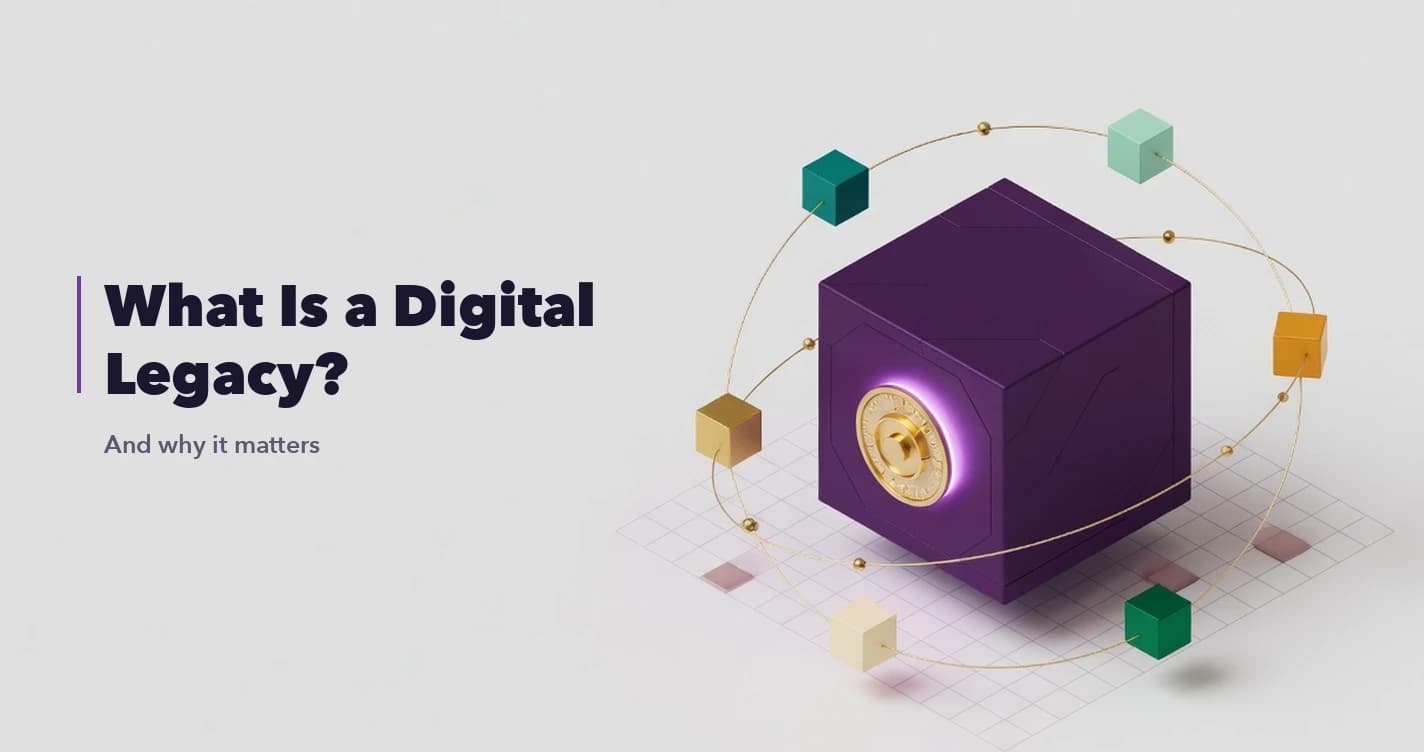
A digital legacy is everything a person leaves behind in digital form: online accounts, stored files and photographs, cryptocurrencies and financial logins, subscriptions, domain names, and the public identity built across social platforms. It matters because most of it is protected by security designed to lock out everyone, including the family left behind.
You have spent years accumulating one. Almost nobody has decided what happens to it.
The average adult now holds well over a hundred online accounts. Some hold money. Some hold irreplaceable photographs. Some hold nothing but a login that quietly renews a charge every month. Together they form an estate that did not exist a generation ago and that traditional inheritance was never designed to handle.
What counts as a digital legacy
It helps to separate the parts, because they fail in different ways and need different solutions.
The financial category is the one people notice. The sentimental category is the one families grieve over. Both are lost for the same underlying reason.
Why it matters
Here is the number that reframes the question. A survey of 1,500 US adults by Bryn Mawr Trust found people valued their own digital assets at an average of $191,516, while 76 percent reported little or no knowledge of digital estate planning and fewer than 15 percent had an estate plan that covered those assets at all.
So this is not a niche concern for people who own Bitcoin. It is a roughly two hundred thousand dollar blind spot sitting in the middle of an ordinary household's balance sheet.
The gap is not closing. Trust & Will's 2026 Estate Planning Report, based on a nationally representative survey of 5,000 US adults, found 56 percent have no estate planning documents at all, and 48 percent have no clear instructions for their digital accounts. Among people who do hold a will, 23 percent still have no digital instructions.
The scale is easier to grasp at the platform level. Researchers at the Oxford Internet Institute calculated that, on 2018 user numbers alone, at least 1.4 billion Facebook members will die before 2100, and that deceased profiles could outnumber living ones by around 2070. That is one platform. Multiply it across every service a person uses and the shape of the problem becomes clear.
And in the financial category, the losses are already permanent. Analysts estimate between 2.3 and 4 million Bitcoin are inaccessible forever, roughly 11 to 18 percent of the total supply that will ever exist. Very little of it was stolen. Most was simply held by someone who died, forgot, or lost a piece of paper.
What happens by default
Doing nothing is itself a decision, and it produces predictable outcomes. Every major platform has a policy, and most people have never opened the setting.
Two things stand out. These tools are opt-in and largely unused, and each one covers a single company. Setting up all of them individually is the closest thing to a solution most people have, and it still leaves the hardest assets uncovered.
Why the law has not solved this
Legislators have moved, and the direction is consistent, but there is a limit to what law can do here.
In the United States, the Revised Uniform Fiduciary Access to Digital Assets Act (RUFADAA) has been adopted in 46 states plus Washington DC. It gives executors a defined pathway to digital assets. Critically, it grants access to the *content* of private communications only where the deceased explicitly consented in advance. Absent that consent, providers are generally limited to metadata.
The United Kingdom's Property (Digital Assets etc) Act 2025 confirmed digital holdings as a form of personal property. In the UAE, Federal Decree-Law No. 46 of 2021 governs electronic transactions, and Dubai Law No. 2 of 2025 gave the DIFC Courts exclusive jurisdiction over enforcement of non-Muslim wills. India's Bharatiya Sakshya Adhiniyam 2023 modernised the treatment of electronic evidence.
Every one of these establishes *who is entitled* to a digital asset. Not one of them can tell a grieving family that the asset exists, which of eleven email addresses it was registered under, or what the passphrase was. Legal entitlement and practical access are different problems. The law solves the first. It cannot solve the second.
That gap is the whole reason digital legacy planning is a distinct discipline rather than a paragraph in a will.
What a digital legacy plan actually contains
A workable plan answers three questions, in this order.
What exists. A complete inventory. Not passwords, an inventory. If nobody knows an account is there, no legal right can ever be exercised over it.
Where it is. Which institution, which jurisdiction, which registered identity. This is what turns a two-year forensic search into an afternoon.
How it opens. Access instructions released to the right person only when defined conditions are met and verified, rather than shared in advance, which would compromise security for the rest of your life.
At BlockWill we call this the ELA framework: Existence, Location, Access. Every inheritance failure we have examined reduces to a breakdown in one of the three.
Practically, that means keeping an inventory that is encrypted and updated rather than a document in a drawer, recording your intentions in a form that can be shown to be authentic and unaltered, and choosing who receives what and under what conditions. It also means doing the boring part: switching on the legacy settings the platforms already give you.
Digital legacy planning does not replace a will. It makes one enforceable. A will transfers legal title. A digital legacy plan makes sure your family knows what title there is to transfer.
Frequently asked questions
What is a digital legacy?
A digital legacy is everything a person leaves behind in digital form, including online accounts, stored photographs and files, cryptocurrencies, subscriptions, domain names and social media identities. It covers both assets with financial value and material with purely personal value.
What is the difference between a digital legacy and digital assets?
Digital assets are the individual items, such as a crypto wallet or a photo library. A digital legacy is the whole of what you leave behind digitally, including accounts with no monetary value and the online identity that persists after death.
Are digital assets covered by a normal will?
Partly. A will can name who inherits them, and in many jurisdictions digital holdings are now recognised as property. But a will cannot tell your executor which accounts exist or how to open them, and wills become public documents in probate, so credentials should never be written into one.
What happens to my online accounts if I do nothing?
It varies by platform. Some memorialise the account, some delete it after a set period of inactivity, and some freeze it indefinitely. Financial accounts in self custody, such as a hardware crypto wallet, generally become permanently inaccessible.
Can my family just use my passwords?
Sharing passwords in advance creates a security vulnerability for the rest of your life, and accessing an account after death using shared credentials may breach the provider's terms of service. Verified conditional release is the safer approach.
Is a password manager enough?
No. Password managers are built for one living user and treat death as an edge case. They record credentials but not what assets exist, and they do not provide verified release to multiple people or evidence of what you intended.
How do I start a digital legacy plan?
Begin with an inventory of every account that holds money, memories or a recurring charge. Then switch on the legacy tools your main platforms already offer. Then decide who should receive what, and record it somewhere secure and updatable.
Does this replace working with a lawyer?
No. A digital legacy plan sits alongside a properly drafted will. Questions about which succession regime applies to your estate remain a matter for qualified legal counsel.
*BlockWill builds digital inheritance infrastructure from the DIFC Innovation Hub, Dubai. See **what BlockWill protects** or **talk to our team**.*