
Imagine you are leaving on a long trip and you need to leave a spare key to your house.
You have options. Under the flowerpot by the door. With the neighbour who waters your plants. In a sealed envelope at your lawyer's office. In one of those little key safes bolted to the wall with a code. Or split between three neighbours, arranged so that any two of them together can open the door and no single one of them can.
None of these is obviously right. The flowerpot is easy for you and easy for a burglar. The lawyer is safe and closed on Sunday. The key safe works until you forget the code.
Now change one thing about the trip. You are not coming back.
Suddenly every option is judged differently. You stop asking "can I get in when I return" and start asking "can the right person get in, on a day I cannot help them, and nobody else, ever." That is the whole problem of an inheritance plan for bitcoin, and it is why the answer is never just "write it down somewhere safe."
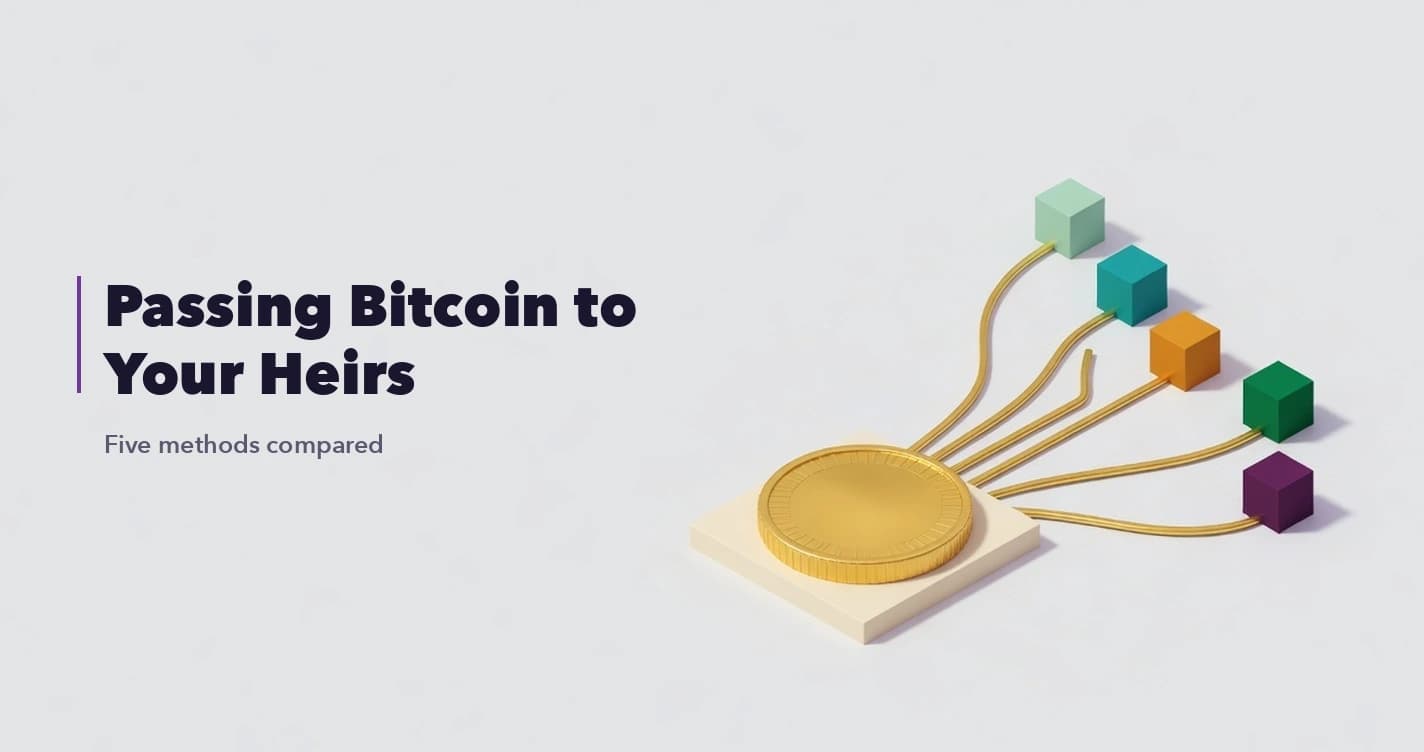
There are five real methods. This post walks through each one, what it costs, and the exact way it fails, because every one of them fails somehow. If you have not seen how badly this goes when nobody plans at all, start with what happens to crypto when someone dies without sharing keys.
The Two Questions Every Method Has to Answer
Before comparing anything, get the test right. Every method is trying to satisfy two demands that pull in opposite directions.
Can they find it? On the worst week of their lives, with no help from you, does your family know the crypto exists, where the keys are, and what to do next? Most plans die here, quietly, because the plan lived in your head.
Can they only find it then? Until that day, is the key genuinely out of reach for everyone including the people you trust most? A key someone can use today is not an inheritance. It is a gift you have not admitted to.
Every method below is a different bet on how to hold those two in tension. Watch which one each method sacrifices.
Method 1: The Written Seed Phrase
You write your twenty-four recovery words on paper or stamped steel, and you hide it. Maybe a home safe, maybe a bank deposit box, maybe both halves in two places.
What it costs: almost nothing. A sheet of steel and an afternoon.
Why people choose it: total control, no company involved, no subscription, nothing to trust but yourself.
How it fails: it fails on findability, and it fails constantly. Your family has to know the backup exists, know where it is, have legal access to that place, and understand that twenty-four words on a card are the money rather than a curiosity. If you added a passphrase, that twenty-fifth secret word that opens a hidden wallet, they need that too, and they need to know to ask for it. A family that recovers a seed, sees an empty wallet, and concludes the money was spent has just walked away from everything.
There is also the quiet risk nobody likes discussing. Anyone who finds that paper before you die owns your coins immediately. The safest hiding place from a burglar is also the safest hiding place from your daughter.
Paper is not a plan. Paper is a component of one.
Method 2: Leaving It on an Exchange
You keep the coins on Coinbase, Binance, or Kraken and let the estate claim them the way it would claim a bank account.
What it costs: nothing extra, plus the trading and custody terms you already accept.
Why people choose it: there is finally somebody to call. Exchanges hold the keys for you, so the asset behaves like a normal financial account. Each of the big platforms has a documented estate process, and they do work.
How it fails: slowly, and not on your terms. The estate needs a certified death certificate and probate documents such as letters testamentary or letters of administration. Accounts are often frozen the moment a death is reported. Timelines run in weeks and often months, and can stretch further if the paperwork comes back wrong. You are also carrying counterparty risk for the whole time you are alive, which is the thing self-custody exists to avoid.
It is the most reliable method for a family that knows nothing about crypto, and the least sovereign one.
Method 3: Multisig With a Partner
Instead of one key, the wallet is built to need several, and a set number of them must sign together. Casa and Unchained both sell this as a product.
Casa's inheritance setup uses a three-key vault where two are needed to move funds: one on your phone, one on your hardware wallet, and one held by Casa as backup. A recipient can request access through the app, which starts a waiting period of several months during which you are notified and can decline. Unchained runs a two-of-three collaborative custody model where you hold two keys and Unchained holds the third, with an inheritance protocol layered on top. Both charge an annual fee, currently in the low hundreds of dollars, so check the live pricing before you plan around it.
Why people choose it: it removes the single point of failure honestly. Losing one key is survivable. A thief needs to compromise two separate things in two separate places.
How it fails: on complexity and on company lifetime. Multisig setups are genuinely harder to hold correctly, and a family that has never seen one will not improvise it under stress. You are also betting that a specific company still exists and still operates this product in twenty or thirty years. That is a long bet on a young industry. Read the recovery documentation and ask what happens to your vault if the company shuts down. If there is no clear answer, that is your answer.
Method 4: A Dead-Man Switch Service
A service checks in with you on a schedule. If you stop responding for long enough, it releases instructions to the people you named. Proton's Inactive Account Manager and various crypto-specific tools work this way.
Why people choose it: it solves timing, which nothing above does. The release happens automatically, without your family needing to know anything in advance.
How it fails: naive builds fail in both directions at once. Release on silence alone and a long hospital stay, a lost phone, or a changed email address can fire the switch while you are alive, publishing your keys to people who then hold them for years while you recover. Make the window long enough to be safe and your family waits months after a genuine death. And if the service holds the secret in readable form, then the company, or anyone who breaches it, can open your wallet on any random Tuesday.
Silence is evidence. It is not proof. Any system that treats the two as the same thing will eventually hurt somebody.
Method 5: An Encrypted Vault With a Verified Release
The last method separates three jobs that the first four keep confusing: recording what exists, controlling who can open it, and deciding when.
This is how BlockWill is built.
SecureVault holds the inventory and the instructions, encrypted on your device before upload, so BlockWill stores a sealed box rather than a readable list. Client-side encryption is what makes that claim real rather than a promise.
The ability to open is split rather than held. Using Shamir's Secret Sharing, the unlocking material is cut into pieces where a set number (say three of five) must be recombined, and a single piece reveals nothing. BlockWill never holds enough pieces to open your vault alone. The threshold signatures guide covers the mathematics.
VaultRelay decides the moment, and it deliberately refuses to accept silence as sufficient. It combines a long inactivity window with repeated contact across several channels, executor attestation, and documentary proof of death. Our dead-man switch post explains why patience is the feature.
How it fails: it needs you to actually fill it in. A vault with three wallets recorded and the fourth forgotten will hand over three wallets. No architecture fixes an incomplete inventory.
Side by Side
The honest reading of that table is that methods one and two are not really competitors. Most families should combine: hold your coins how you like, and keep the map to them somewhere that survives you. Our wider guide to crypto inheritance covers the legal groundwork sitting underneath all five.
Frequently Asked Questions
What is the simplest way to pass bitcoin to my heirs?
If your family knows nothing about crypto, custody on a major exchange is the simplest, because there is a company with a documented estate process. If you hold your own keys, the simplest workable plan is an encrypted inventory plus a release mechanism, so your family never has to find a hidden object without help.
Can I just give my seed phrase to my son now?
You can, and you should understand what you have done. He owns those coins from that moment. Not legally in every sense, but practically and irreversibly, because possession of the key is the ownership. If that is genuinely what you intend, it is fine. If you intended it to take effect later, this does not do that.
Is multisig better than a single key for inheritance?
For security, clearly yes, because no single stolen key loses your money. For inheritance, only if your heirs can actually operate it. A three-key vault your family cannot use is a more expensive way to lose the same money.
How long does an exchange take to release crypto to an estate?
Plan for weeks at minimum and months as the normal case. Coinbase's estate transfers commonly run four to eight weeks once complete documents are in, and incomplete paperwork restarts the clock.
Should I split my seed phrase in half and give a half to two people?
No. Splitting a phrase in half is one of the worst things you can do. Half a phrase drastically weakens the security while still requiring both halves to survive, so you have made it easier to steal and easier to lose. If you want splitting, use Shamir's Secret Sharing, which is designed for it and lets any three of five pieces rebuild the secret.
What happens if the company holding part of my plan goes out of business?
Ask that question before you sign up, of any provider including this one. The right answer is that your assets remain recoverable without the company, because the company never held enough to open your vault in the first place. If the answer is "we would notify you," keep looking.
Do I still need a will if I use one of these?
Yes. These methods handle technical access. A will handles legal ownership, and they are different problems. Never put the actual keys in the will, since a will filed for probate becomes a public record.
The Bottom Line
Five methods, and not one of them is free of a real cost. Paper costs findability. Exchanges cost sovereignty. Multisig costs complexity. A crude dead-man switch costs safety. A vault costs the discipline of keeping it current.
Anyone who tells you otherwise is selling something.
What separates a working plan from a hopeful one is not which method you pick. It is whether you were honest about the failure mode and covered it deliberately. The paper holder who told two people where the steel plate lives has a better plan than the multisig user who never wrote down how it works.
Pick the method that matches how much your family already understands. Then go and check the thing you assumed they knew.
They probably do not know it.