

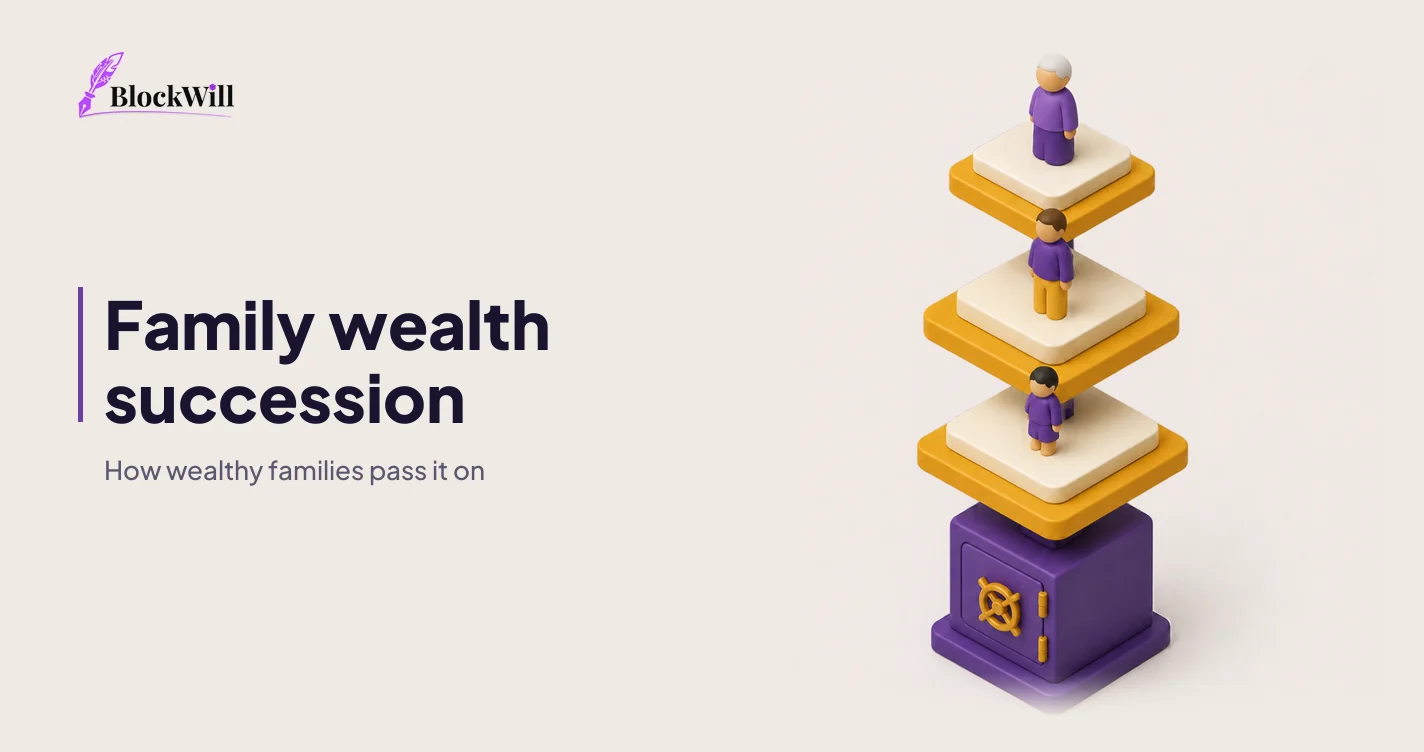
What family wealth succession planning is
Estate planning asks what happens to your property when you die or lose capacity. The what is estate planning guide covers that ground. Wealth succession planning asks a longer question: how does a family keep its wealth, and its ability to manage that wealth, intact across several generations? It treats the transfer as one event inside a decades-long project.
That project has five parts, and most failed plans skip at least one.
- Structure. The wills, trusts, partnerships and companies that hold the assets and decide how they pass.
- Tax. Using exemptions and timing so that each generation does not lose a large slice to estate, gift or income tax.
- Governance. Who makes decisions once the founder is gone, how disagreements are settled and how new family members join.
- Heirs. Whether the next generation knows the plan, understands the assets and is ready to run them.
- The record. A complete, current picture of what the family owns, where it is, who holds which part and what should happen to it.
The stakes are large. Cerulli Associates projects that 124 trillion dollars will change hands in the United States through 2048, 105 trillion of it to heirs, with 62 trillion coming from high-net-worth and ultra-high-net-worth households. Globally, the UBS Global Wealth Report 2025 expects more than 83 trillion dollars to move over the next 20 to 25 years. The great wealth transfer guide looks at those numbers in detail.
Shirtsleeves to shirtsleeves: what the research says
Almost every culture has a proverb for wealth that disappears in three generations. In English it is "shirtsleeves to shirtsleeves", in Lancashire "clogs to clogs", and in Chinese a saying that wealth does not last beyond three generations. The idea is old. The statistics usually attached to it are newer and less solid than they sound.
The 70 percent figure
The number most often quoted comes from Roy Williams and Vic Preisser of The Williams Group, whose 2003 book Preparing Heirs reported that 70 percent of wealth transitions fail, meaning the family involuntarily loses control of the assets. They based it on about 3,250 interviews with families over two decades, and attributed the failures mainly to breakdowns of trust and communication (about 60 percent) and unprepared heirs (about 25 percent), with only a small share down to taxes, legal errors or poor professional advice.
That diagnosis is useful. The 70 percent is another matter. The work was not peer reviewed and its data has not been published. Family wealth psychologist Jim Grubman, writing for the Family Firm Institute, traced the claim back and found it rests on a 1987 study by John Ward of 200 manufacturing businesses in Illinois. That study measured whether a family business stayed in family hands, not whether a family stayed wealthy. A 30 percent continuity rate became a 70 percent failure rate, and then a rule about all family wealth.
Josh Baron and Rob Lachenauer reached the same conclusion in the Harvard Business Review in 2021, noting that Ward's finding is often misquoted: about a third of his firms survived through the second generation, which is not the same as only a third surviving into it. A family that sells its company for a good price has not failed, yet it counts as a failure in continuity statistics.
What better evidence shows
Large individual fortunes do shrink. Robert Arnott, William Bernstein and Lillian Wu found in the Cato Journal that only 69 of the 400 people on the 1982 Forbes 400, or their descendants, were still on the list in 2014. Spending, taxes, division among more heirs and ordinary investment risk all pull a fortune apart over time.
Social standing is stickier. Economic historian Gregory Clark's The Son Also Rises tracked surnames across centuries and found that family advantage persists far longer than standard mobility estimates suggest. So the honest summary is this: the great fortune is usually divided and diluted within a few generations, but families that plan well can stay comfortable, cohesive and in control of what they have for much longer.
Wealthy family succession examples
Four families illustrate the pattern well because their stories are documented in court records, company history or reputable reporting. Two lost control. Two kept it.
| Family | Source of wealth | What happened | Outcome |
|---|---|---|---|
| Vanderbilt | Shipping and railroads; about 100 million dollars at the founder's death in 1877 | Divided among many heirs, spent on houses and lifestyle, no shared structure | No millionaire among 120 descendants at a 1973 reunion, per a family historian |
| Gucci | Florence leather goods house founded in 1921 | Third-generation lawsuits and feuds over control of the company | Family fully out of the business by 1993 |
| Rockefeller | Standard Oil | Family office from 1882, long-term trusts from 1934, organised philanthropy | Still a recognised family fortune and family office five generations on |
| Walton | Walmart | Family partnership from 1953, early gifts to children, GRATs and charitable lead trusts | Still controls Walmart through the family holding company |
The Vanderbilts: a fortune with no structure
Cornelius Vanderbilt died in 1877 as one of the richest men in American history, with a fortune of roughly 100 million dollars built on shipping and railroads. Within a few generations it had been divided among a growing number of heirs and spent on Fifth Avenue mansions, Newport summer houses and the way of life that went with them. Arthur T. Vanderbilt II, a descendant, wrote in Fortune's Children (1989) that when 120 of the Commodore's descendants gathered at Vanderbilt University in 1973, there was not a millionaire among them, a point Forbes has also recounted. No family office, no shared holding structure and no shared purpose kept the pieces together.
The Guccis: lost through conflict
Gucci was founded in Florence in 1921 and ran as a family company into the third generation. When Rodolfo Gucci died in 1983, his son Maurizio inherited a majority stake and launched a legal war to push his uncles out of the business. He won control, but by 1993 his spending and the company's debts forced him to sell his 50 percent stake to the company's outside investors, ending the family's ownership, as TIME has documented. The brand survived and thrived. The family's hold on it did not.
The Rockefellers: structure, office and purpose
John D. Rockefeller set up a family office in 1882 to manage the family's investments and affairs. It still exists as Rockefeller Capital Management, which traces its origin to that office. His son, John D. Rockefeller Jr., placed much of the family's wealth into long-term trusts for his children in 1934 and for his grandchildren in 1952, as Peter Collier and David Horowitz describe in The Rockefellers: An American Dynasty. The family also built shared institutions, from the Rockefeller Foundation to the Rockefeller Brothers Fund, that gave later generations a common project and a reason to stay connected.
Case study · United States, Walton v. Commissioner, 115 T.C. 589 (2000)
The Waltons: giving early and using the tax code as written
In 1953, long before Walmart was a large company, Sam Walton organised the family's business interests as a partnership and gave each of his four children a 20 percent stake, keeping 20 percent for himself and his wife Helen. In his autobiography Made in America he wrote that the best way to reduce estate taxes is to give assets away before they appreciate.
The family later used grantor retained annuity trusts. Audrey Walton, widow of Walmart co-founder Bud Walton, put Walmart shares into two short GRATs in 1993. The IRS challenged how the gift was valued, and the US Tax Court ruled for her in Walton v. Commissioner in 2000, effectively approving the "zeroed-out" GRAT that many families now use. Bloomberg reported in 2013 that the family had also used charitable lead annuity trusts, and that Walton Enterprises, the family holding company, still holds its Walmart stock.
The lesson from all four is not that tax tricks preserve wealth. It is that the families who kept control decided early how the wealth would be held, who would run it and what it was for, and wrote those decisions down.
Seven strategies that hold
- Start early. Assets given or placed in trust before they grow carry their future growth outside your estate. This was the core of the Walton approach and it works at any scale.
- Hold assets in one structure. A family partnership, LLC or holding company keeps assets together, sets voting and transfer rules, and stops a single heir's divorce or debt from breaking up the whole.
- Use trusts that outlast one generation. An irrevocable trust, set up to last as long as state law allows, keeps assets from being taxed and divided at every death.
- Write down the governance. A family constitution or charter, a family council and regular meetings decide who has a say, how decisions are made and how disputes are settled before there is a dispute.
- Prepare heirs deliberately. Education, responsibility in stages and honest conversation, covered in more detail below.
- Give the family a shared purpose. A foundation or donor-advised fund that the next generation helps run is often the first place heirs learn to make decisions together.
- Keep a single, current record. Every asset, where it is held, who should receive it and how to reach it, updated as things change.
The trust and will toolkit
Searches for family wealth succession planning often ask "trust or will?" The answer for most wealthy families is both, plus a few more tools. The will vs trust guide compares the first two on twelve points. The table below adds the tools used for multi-generation planning in the United States.
| Tool | What it does | Usually fits |
|---|---|---|
| Will | Names an executor and guardians; passes probate property | Every family, as the backstop |
| Revocable living trust | Avoids probate, covers incapacity, keeps terms private | Families with a home, property in several states, or privacy needs |
| Irrevocable or dynasty trust | Holds assets for several generations outside each heir's taxable estate | Wealth above the lifetime exemption, or a wish to keep assets together |
| GRAT | Passes growth above an IRS rate to heirs with little or no gift tax | Concentrated, fast-growing assets such as founder stock |
| Charitable lead trust | Pays a charity first, then passes the remainder to family | Families with philanthropic goals and large estates |
| Family partnership or holding company | Keeps assets under one roof with clear voting and transfer rules | A family business or a portfolio the family wants to manage together |
| Buy-sell agreement | Sets who may buy a departing owner's shares and at what price | Any business with more than one family owner |
| Family office or council | Coordinates investment, tax, records and family decisions | Larger, multi-household families |
The tax backdrop in 2026
For 2026 the federal basic exclusion is 15 million dollars per person, and the annual gift exclusion is 19,000 dollars per recipient, according to the IRS. Married couples can effectively double both. Transfers that skip a generation, such as gifts to grandchildren or to a dynasty trust, also face the generation-skipping transfer tax, which has its own exemption. Several states levy their own estate or inheritance taxes at much lower thresholds, so the state you live in, and where your property sits, still matters.
Preparing the next generation
If the practitioner research and the documented cases agree on one thing, it is that unprepared heirs and family conflict undo more wealth than tax ever does. Families that pass wealth on well tend to do the same few things.
- Talk early, in stages. Values and responsibility in childhood, the outline of the plan in early adulthood, the figures when heirs are ready to act on them.
- Give real, limited responsibility. A small portfolio to manage, a seat on the family foundation board, an observer role on the investment committee. Mistakes made with a small sum at 25 are cheap lessons.
- Teach the basics. How the assets are held, what a trust distribution is, how tax works on inherited property, and how to read the advice they will be given.
- Encourage independent careers. Heirs who have built something of their own make better owners and better decision makers.
- Explain the unequal parts. A child who runs the business and a child who does not may receive different things. Saying why, in writing and in person, prevents most of the resentment that leads to litigation.
The guide to preventing family inheritance disputes covers how to hold these conversations, and the inheritance planning guide covers how to decide shares, timing and conditions for each heir.
The record that makes it work
Every strategy above assumes the next generation can find the wealth. In practice, executors and heirs often start with a collection of statements, a few passwords and a lot of guesswork. Wealthy families have more of this problem, not less: more accounts, more entities, more countries, more advisers, and more assets such as crypto that cannot be recovered by a court order.
Large families solve it with a family office that holds the master record. Most families do not have one, but they need the same thing: an inventory of everything the family owns (property, accounts, investments, businesses, insurance, digital assets), who should receive each part, the recorded intent behind the will, and a way to release it to the right people at the right time and not before.
That is what BlockWill is built for. It is wealth continuity infrastructure: an encrypted, zero-knowledge record of what a family owns and who should receive it, with will intent recorded in DigiWish to support the will a lawyer prepares, and VaultRelay to release the record on conditions you set. It does not replace the trusts, the will or the advisers. It makes sure the people who inherit can act on them.
Family offices running succession across several generations can see how this works at scale on the family office solutions page.
Succession planning checklist
- Build a complete inventory of the family's assets, entities and liabilities, and keep it encrypted and current.
- Decide what the wealth is for and write it down: security, opportunity, a business, philanthropy.
- Choose the structure: will, revocable trust, long-term irrevocable trusts, a holding company where it fits.
- Fund every structure. Retitle property and accounts, and check every beneficiary designation.
- Use the annual gift exclusion and lifetime exemption deliberately, with advice on GRATs or charitable trusts if the estate is large.
- Set governance: who decides, how, and how disputes are settled.
- Prepare heirs with education, staged responsibility and an honest conversation about the plan.
- Plan the handover: who confirms a death or incapacity, what information is released, and to whom.
- Review after every birth, death, marriage, divorce, sale or move, and every few years regardless.
Frequently asked questions.
What is family wealth succession planning?
It is the work of passing a family's wealth, and the ability to manage it, from one generation to the next. It includes the legal documents (wills, trusts, ownership structures), the tax plan, the governance that decides who controls what, the preparation of heirs, and a clear record of what the family owns. Estate planning is one part of it; succession planning also asks how the family will run the wealth after the transfer.
Is it true that 70 percent of wealthy families lose their wealth?
The figure is widely quoted but weakly supported. It comes from consultants Roy Williams and Vic Preisser, who said 70 percent of wealth transitions fail, based on interviews with families rather than a published, peer-reviewed study. Researchers who traced the number back found it echoes a 1987 study of 200 Illinois manufacturing firms that measured business continuity, not family wealth. Large fortunes do fragment over generations, but the precise 70 percent is not a measured fact.
What strategies do rich families use to pass on wealth?
The recurring ones are giving assets away early, before they grow; holding the family's assets in a single structure such as a family partnership or holding company; using irrevocable and long-lasting trusts; using tax-efficient trusts such as GRATs and charitable lead trusts; setting up a family office or shared governance; and preparing heirs through education, responsibility and open conversation. Most failures come from family breakdown rather than tax.
Do I need a trust or a will for family wealth succession?
Usually both. A will names guardians and an executor and catches anything outside other structures. A revocable living trust keeps assets out of probate and covers incapacity. Families planning across several generations add irrevocable trusts, often set up to last as long as state law allows, so assets are not taxed and divided at every death. Which combination fits depends on the size and type of the assets and the state or country involved.
How do successful families prepare the next generation?
By talking about the wealth early and in stages, giving heirs real but limited responsibility (a small fund to manage, a seat on a family council or a charitable board), teaching the basics of investing and tax, encouraging careers outside the family business, and explaining the plan while the older generation can still answer questions. Families that keep the plan secret tend to see more disputes and worse decisions after the transfer.
How much can I give my children tax free in 2026?
In the United States you can give up to 19,000 dollars per recipient in 2026 without using any lifetime exemption, and married couples can give twice that. Above that, gifts count against the lifetime basic exclusion, which is 15 million dollars per person for 2026. Most families never pay federal gift or estate tax, but state taxes and the rules on generation-skipping transfers still matter.
What is the most common reason family wealth is lost?
Not tax. The practitioner research, for all its limits, points the same way as the documented cases: breakdowns of trust and communication inside the family, heirs who were never prepared for the responsibility, and no shared sense of what the wealth is for. Practical failures add to it, such as assets nobody knew about, accounts nobody can open and documents that contradict each other.
Make Sure the Next Generation Can Find It
Trusts and wills decide who inherits. BlockWill makes sure they can act: an encrypted, zero-knowledge record of everything your family owns, who should receive it, your will intent recorded in DigiWish, and VaultRelay to release it to the right people when the time comes.
Keep reading.
This article is for general information only and is not legal, tax, or financial advice. Estate and inheritance laws change and vary by jurisdiction and personal circumstances. Always consult a licensed attorney or advisor in the relevant jurisdiction before acting. Case studies marked as illustrative are composite scenarios, not real client records.