

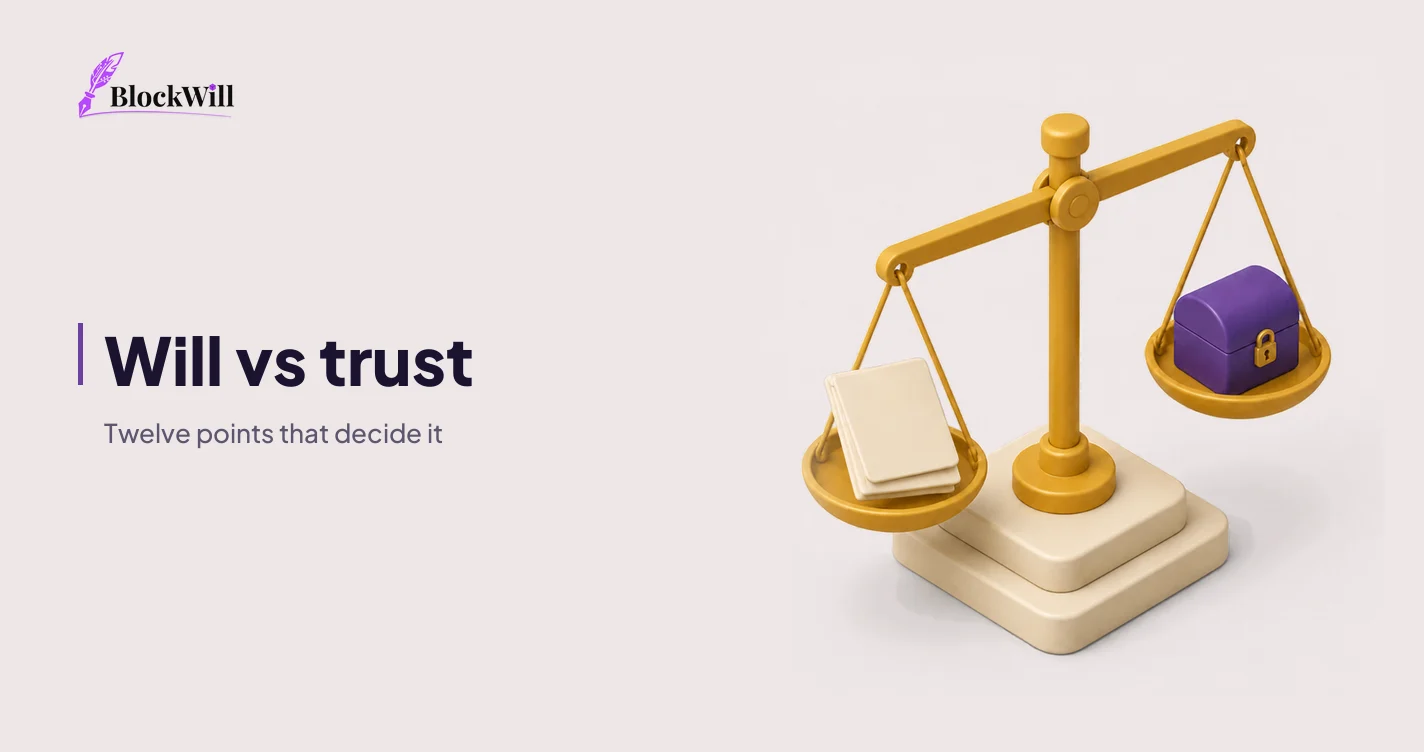
What a will does and what a trust does
A will
A last will and testament is a signed, witnessed document that takes effect only when you die. It does four things: names an executor to wind up your affairs, says who receives your property, nominates a guardian for minor children, and can set up a trust for those children that comes into existence at your death (a testamentary trust). Until you die, a will does nothing at all. You can change or revoke it at any time while you have capacity.
Everything a will passes goes through probate, the court process that validates the will, appoints the executor, settles debts and transfers title. Probate is public. Anyone can read the will, the inventory and the names of the beneficiaries once they are filed.
A trust
A trust is a legal arrangement in which one person, the trustee, holds property for the benefit of others, the beneficiaries, under written terms. The kind compared with a will in this guide is the revocable living trust: you create it while alive, you are usually the first trustee and beneficiary, you can change or cancel it, and you name a successor trustee to take over if you become incapacitated or die.
The defining step is funding. A trust controls only what has been transferred into it: the house deeded to the trustee, the brokerage account retitled, the business interest assigned. Those assets pass under the trust's terms without probate. Property left outside the trust passes under your will as if the trust did not exist.
Irrevocable trusts are a different tool. They are used for tax, asset protection and benefits planning, cannot be freely changed, and are not a substitute for a will. When people search for will vs trust, they almost always mean the revocable living trust, and that is the comparison below.
Will vs trust: twelve points that decide it
| Point | Will | Revocable living trust |
|---|---|---|
| Takes effect | At death | When signed and funded, during life |
| Probate | Yes, for everything it passes | No, for assets titled in the trust |
| Public record | Yes, once filed with the court | No |
| Incapacity | Does nothing | Successor trustee steps in |
| Guardian for minor children | Yes | No |
| Names an executor | Yes | Names a trustee instead |
| Upfront cost | Lower | Higher |
| Ongoing work | Update when life changes | Keep it funded as assets change |
| Control after death | Outright gifts at probate close | Staged or conditional distributions |
| Out-of-state property | Separate probate in each state | One trust covers all |
| Challenges | Contested in probate court | Harder to contest, though not immune |
| Digital assets | Authority only | Authority only |
Three rows carry most of the weight. Probate decides time, cost and publicity. Incapacity decides who manages your affairs if you are alive but unable to act, which is statistically far more likely in any given year than death. Guardianship is the one thing a trust cannot do, and the reason a will remains part of nearly every plan.
Probate, privacy and incapacity
Probate
Probate exists to make sure a will is genuine, debts are paid and property reaches the right people. The price of that certainty is time and money. Uncontested probate commonly takes several months to over a year, and in many states the court and attorney fees run to several percent of the estate. If you own real property in more than one state, each state runs its own probate (ancillary probate), with its own fees and lawyer. Many states offer a simplified process for small estates below a dollar threshold, and some assets, such as retirement accounts with named beneficiaries, joint property and life insurance, pass outside probate regardless of which document you use.
A funded revocable living trust avoids this for everything inside it. The successor trustee takes over on your death, usually within days, and distributes under the trust's terms without filing anything with a court.
Privacy
A probated will is a public record. Your assets, their values, your debts and the names of the people who inherit can be read by anyone who asks the court clerk, including people who sell to recently bereaved families. A trust is private. Its terms are disclosed to the beneficiaries and trustee, not to the public. For families with a business, a public profile or a complicated set of relationships, this is often the deciding factor.
Incapacity
A will does nothing while you are alive. If a stroke or dementia leaves you unable to manage your affairs, your family's options are a durable power of attorney, if you signed one, or a court conservatorship, which is slow, public and expensive. A revocable living trust names a successor trustee who steps in for the assets in the trust, under rules you wrote, without a court. Most complete plans still add a durable power of attorney for the assets outside the trust and for decisions a trustee cannot make.
What each costs, including probate
The will is cheaper on the day you sign it. The trust is often cheaper over the whole life of the plan. Prices vary a great deal by state and by the complexity of the estate, so treat the ranges below as orientation, not quotes.
- Will. Online services from free to a couple of hundred dollars. An attorney-drafted simple will commonly from a few hundred dollars to around 1,000 dollars, more for complex estates. Then probate at death, which is the hidden cost.
- Revocable living trust. An attorney package, usually with a pour-over will, powers of attorney and health care directives, commonly from roughly 1,500 to 3,500 dollars and up. Add recording fees and the time to retitle each asset. Then little or nothing at death, provided it was funded.
- Probate. Court fees, executor compensation, appraisals and attorney fees. In states with statutory fee schedules the attorney and executor fees are each calculated as a percentage of the gross estate, not the net, so a house with a mortgage is charged on its full value.
Which one you need
The question is less "will or trust" than "how much of my estate should pass outside probate, and do I need to plan for incapacity". A short diagnostic:
A will alone may be enough if
- You rent, or own no real property.
- Most of your wealth is in retirement accounts, life insurance or joint accounts that already pass by beneficiary designation or survivorship.
- Your estate is below your state's small-estate threshold.
- Your main concern is naming a guardian for your children.
A revocable living trust is usually worth it if
- You own a home, or property in more than one state.
- You want your estate to stay private.
- You want someone able to manage your affairs if you are incapacitated, without a court.
- You want staged distributions: for example, a beneficiary receives income at 21 and principal at 30, or a family member with a disability is provided for without losing benefits.
- You have a blended family, a business, or beneficiaries who do not get along, and want to make a challenge harder.
- You hold crypto or other credential-dependent assets, where months of probate delay are a real risk.
Why most plans use both
A well-built plan with a trust at its centre still contains a will, for two reasons. First, the will is the only place to nominate a guardian for minor children. Second, something is always left outside the trust: the car bought last spring, the account opened after signing, the refund that arrives after death. A pour-over will says that anything outside the trust at death is to be transferred into it. That property still goes through probate, but it ends up under the trust's terms rather than under intestacy rules.
- Revocable living trust. Holds the house, the accounts and anything else you retitle. Names a successor trustee and sets the distribution rules.
- Pour-over will. Names a guardian, names an executor, and sweeps anything left outside into the trust.
- Durable power of attorney and health care directive. Cover decisions and assets a trustee cannot reach while you are alive.
- Beneficiary designations. Retirement accounts and life insurance pass by designation, which overrides both the will and the trust. Review them when either document changes.
What neither a will nor a trust can do
Both documents can give someone authority over your digital property. Under RUFADAA, which 47 states have adopted, a will, trust or power of attorney can authorise an executor or trustee to obtain account records from a provider, and a trust can hold crypto or a domain name like any other asset. The state-by-state RUFADAA guide explains how that authority ranks against a provider's own settings.
What neither document can do is produce access. A trustee with perfect legal authority cannot reconstruct a seed phrase, open a hardware wallet, pass two-factor authentication on a phone that was wiped, or find the account nobody knew existed. And neither document should contain the secrets that would, because a will becomes a public record and a trust is read by every beneficiary and trustee.
The practical answer is to keep three things separate and connected: the legal document that grants authority, an encrypted inventory of what exists and what should happen to it, and a secure arrangement for the keys that releases them to the right person at the right time. BlockWill is built as the second and third parts. SecureVault holds the inventory and instructions, encrypted on your device. VaultRelay releases them on conditions you set, with a cooldown an executor can cancel. The key is handed to your beneficiary in person during the Ceremony, so no document and no server ever holds it. The dead man's switch guide explains the release mechanics, and the US digital estate planning guide shows how to word the trust's digital-asset powers.
Online services can draft both documents; how one of them sits next to BlockWill is set out in BlockWill vs Trust & Will.
A note for the UAE and cross-border families
The will vs trust question looks different outside the United States. In the UAE, inheritance for Muslims follows Sharia by default, and non-Muslim residents who want their own distribution rules register a will with the DIFC Wills Service Centre or the Abu Dhabi Judicial Department. Trusts are available under the DIFC Trust Law and are used mainly by families with substantial or multi-jurisdiction wealth, often alongside a foundation. A will registered in Dubai does not govern assets in Texas, and a US trust does not automatically control a Dubai apartment. The UAE expat estate planning guide and the cross-border inheritance guide cover what has to be done in each place.
Frequently asked questions.
What is the difference between a will and a trust?
A will is a document that takes effect when you die. It names an executor, says who inherits, and can name guardians for minor children, but everything it passes goes through probate court. A trust is a legal container you create and fund while alive. A trustee manages the assets inside it for your beneficiaries, during your life if you become incapacitated and after your death, without probate.
Is a trust better than a will?
Neither is better in the abstract. A trust avoids probate, keeps the estate private and covers incapacity, at a higher upfront cost and with ongoing work to keep it funded. A will is cheaper and simpler, and it is the only document that can name a guardian for minor children. Most complete plans use both: a funded revocable living trust plus a pour-over will that catches anything left outside it.
Does a trust avoid probate?
Only for assets that were actually transferred into it. A trust avoids probate for the house, accounts and other property titled in the trust's name. Anything you forgot to retitle, or acquired after signing and never moved, still passes under your will and goes through probate. An unfunded trust avoids nothing.
How much does a will cost compared to a trust?
In the United States an attorney-drafted simple will commonly runs from a few hundred dollars to around 1,000 dollars, and online services charge less. A revocable living trust package from an attorney commonly runs from roughly 1,500 to 3,500 dollars or more depending on the state and the estate, plus the cost of retitling assets. Compare that with probate, which in many states consumes several percent of the estate and months of time.
Can a trust name a guardian for my children?
No. Guardianship nominations for minor children are made in a will. A trust can hold and manage the money for those children, and say at what ages they receive it, but the person who raises them is named in the will. This is the main reason a plan built around a trust still needs a will.
Do a will or a trust give my family access to my digital assets?
They give legal authority, not access. An executor or trustee with the right document can ask a provider for account data under RUFADAA, but neither document can reconstruct a password, a seed phrase or a hardware key. Those need a separate, encrypted arrangement that the document points to without containing.
Give the Document Something to Point At
A will or a trust decides who has authority. BlockWill gives that person what they need to use it: an encrypted inventory of every asset, documented wishes in DigiWish, and VaultRelay to release access on your conditions with a cooldown an executor can cancel. Build the vault your estate plan refers to.
Keep reading.


This article is for general information only and is not legal, tax, or financial advice. Estate and inheritance laws change and vary by jurisdiction and personal circumstances. Always consult a licensed attorney or advisor in the relevant jurisdiction before acting. Case studies marked as illustrative are composite scenarios, not real client records.