
Imagine an old train. The driver holds a lever, and as long as their hand presses down on it, the train keeps running safely. But if the driver faints, or lets go, or simply stops responding, the lever springs up on its own and the train brakes to a stop.
The clever part is the direction of the logic. The system does not wait for the driver to say "something is wrong." It waits for the driver to keep saying "everything is fine." The moment those reassurances stop, the machine assumes the worst and acts to keep everyone safe.
That lever has a name. It is a dead-man switch. And it sits at the very heart of how a digital will knows the right moment to act. Because a will faces a question no other software has to answer: how does a system know its owner is gone, when the owner is the one person who can no longer tell it anything?
This is the engineering story of how you build that switch so it never fires too early, never fails to fire when it must, and keeps working perfectly whether you have ten users or ten million.
The Question Only a Will Has to Answer
Most software waits for you to do something. You click a button, it responds. You send a request, it replies. The user drives, the system follows.
A will breaks this pattern completely. The one event that must trigger it, your passing, is precisely the event after which you can never click anything again. The system cannot wait for you to confirm. It has to notice your silence and act on it.
But silence is dangerous to act on. People go quiet for all sorts of innocent reasons. You take a long vacation. You lose your phone. You go to the hospital and recover. You change your number. You simply forget to check in. If the system treats every silence as death, it will fire when you are very much alive, unlocking your most private wishes to your family while you are sitting on a beach. That is a catastrophe in the other direction.
So the real engineering problem is not "detect death." It is "tell the difference between a person who is gone and a person who is merely quiet, and never, ever get it wrong in a way that cannot be undone." Everything that follows is about building enough patience, enough checking, and enough safety into the switch that it earns the right to act.
The Heartbeat: The Foundation of It All
The simplest version of a dead-man switch is a heartbeat. On a regular schedule, the system asks you, gently, "are you still there?" You answer, perhaps by opening the app, tapping a link in an email, or responding to a message. Each answer is a heartbeat, a small proof of life that resets the clock.
As long as the heartbeats keep coming, nothing happens. The will stays sealed. The moment the heartbeats stop, the system starts paying attention. But, crucially, it does not act immediately. One missed heartbeat means almost nothing. People miss check-ins constantly. The system simply notes it and waits.
The design questions here are deceptively deep. How often should the heartbeat be? Too frequent, and you annoy people into ignoring it, which makes the whole signal meaningless. Too rare, and the system is slow to notice when something genuinely has happened. A good rhythm respects the user's life: frequent enough to be meaningful, rare enough to be welcome. Many systems let the user choose, because someone's tolerance for check-ins is personal.
There is also a subtle trap to avoid: the heartbeat must be easy to send but hard to send by accident on someone else's behalf. If a stranger or a family member could fake your heartbeat, they could keep your will sealed long after you are gone, which defeats the point. So a heartbeat has to genuinely prove it came from you, tied to something only you control.
Escalation Tiers: Patience With Teeth
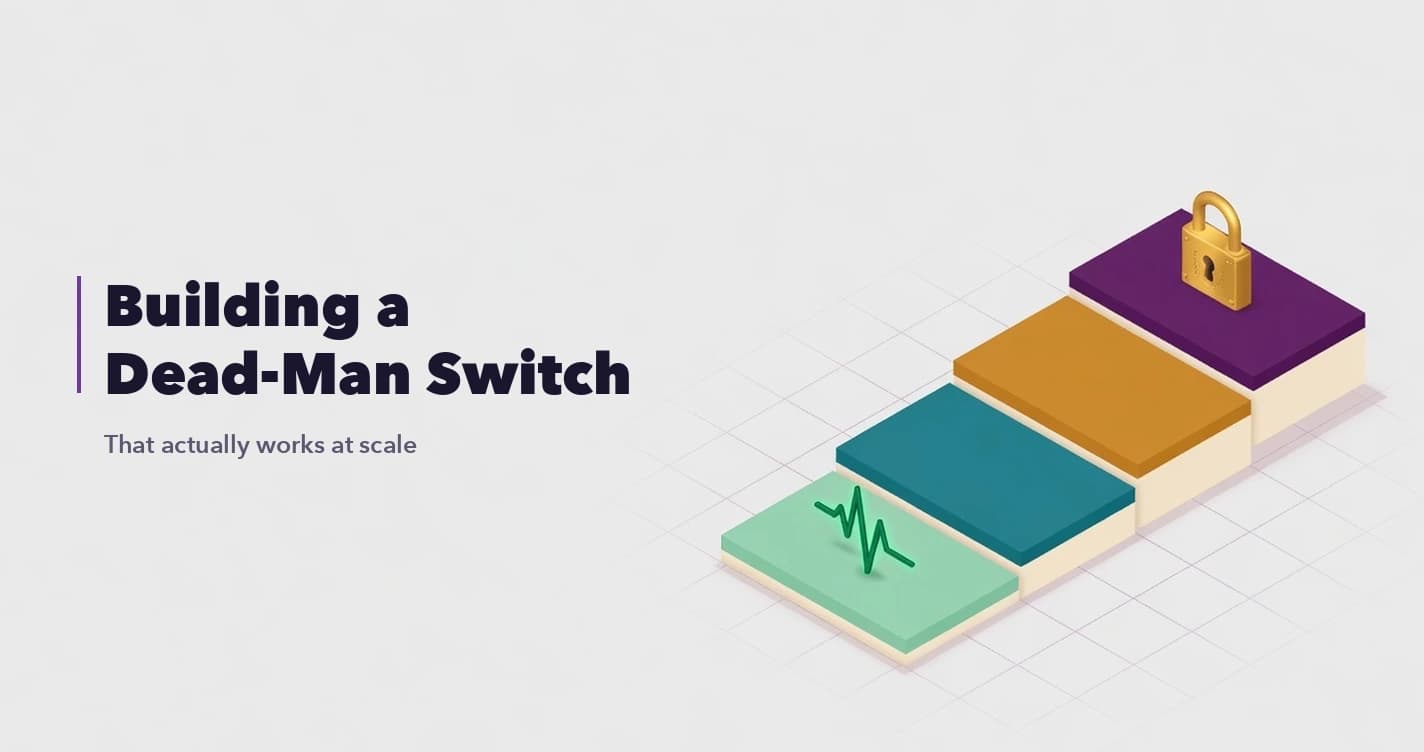
A single missed heartbeat should never trigger anything serious. But a will cannot wait forever either. The answer is escalation, a staircase of responses that grows more serious the longer the silence lasts. Each step buys time and gathers more certainty before the irreversible step is ever reached.
Picture the tiers like this. In the first tier, after you miss your scheduled check-in, the system simply reminds you. A friendly nudge. "We have not heard from you, just checking in." Most silences end right here, because the person was just busy.
If that nudge goes unanswered, the second tier widens the net. The system tries harder to reach you, through more channels and more often. Email, then a message, then perhaps a call. It is no longer a gentle reminder, it is the system actively trying to find you, giving you every chance to prove you are fine.
If you still do not respond, the third tier brings in other people. The system reaches out to the trusted contacts you named ahead of time, the people who would know your situation. "We have been unable to reach this person for a while. Can you confirm they are alright?" These contacts are a human safety check that no automated signal can match. A living person can confirm you are on a silent retreat. They can also confirm the hard truth, if it has come.
Only after all of these tiers have been exhausted, after enough time has passed and enough channels have gone silent and enough people have either confirmed the worst or been unable to vouch for you, does the final tier begin the actual process of acting on your will. By the time the switch truly fires, it has been weeks or months of patient, escalating checking, not a hasty reaction to one quiet weekend.
The escalation staircase is what turns a crude "silence equals death" rule into something humane and trustworthy. Each step costs only time, and time is exactly what protects you from a false trigger.
Fail-Safe vs. Fail-Secure: Which Way Should It Break?
Every safety system has to answer one defining question: when something goes wrong inside the system itself, which way should it fall? This is the difference between fail-safe and fail-secure, and for a will it is one of the most important design decisions of all.
A fail-safe system, when in doubt, opens. The train brakes. The door unlocks in a fire so people can escape. The default, when the system loses certainty, is the action that prevents the worst physical harm.
A fail-secure system, when in doubt, stays locked. The bank vault that seals itself when the power fails. The default, when the system loses certainty, is to protect the contents rather than release them.
For a will, the stakes pull in both directions, and getting the balance right is everything. If the system errs toward firing whenever it is unsure, it risks unlocking your will while you are alive, an irreversible privacy disaster. If it errs toward never firing when it is unsure, it risks your wishes staying sealed forever, your family locked out, your estate frozen.
The right answer is that the irreversible step, actually unlocking and distributing your will, must be fail-secure. When the system is uncertain, it must not release your secrets. Uncertainty should always buy more time and more checking, never trigger the point of no return. But the warning and escalation steps can lean fail-safe, erring toward reaching out more, nudging more, involving humans more. In other words: be eager to check on you, but extremely reluctant to act. The system should knock on every door it can find, and only open yours when it is truly, verifiably certain.
Why "At Scale" Changes Everything
A dead-man switch for one person is easy. You could almost do it with a calendar reminder. A dead-man switch for millions of people, each with their own schedule, their own contacts, their own escalation rules, running reliably for decades, is a serious engineering challenge. Scale changes the nature of the problem in ways that are not obvious until you hit them.
The first challenge is timekeeping. The whole system runs on schedules: when a heartbeat is due, when to escalate, how long to wait at each tier. Computers do not all agree perfectly on what time it is, and clocks drift. If the system trusts a single clock that runs fast or slow, it could escalate too early or too late for huge numbers of people at once. A robust design treats time carefully, never letting a single faulty clock decide something irreversible, and always favoring more delay over less when the timing is unclear.
The second challenge is reliable scheduling. With millions of users, there are millions of future events that must each fire at exactly the right moment, even years from now, even if servers restart, even if parts of the system fail. A heartbeat check that silently gets skipped because a server crashed is a serious bug, because it could either falsely advance someone toward escalation or fail to notice a real silence. The scheduling has to be durable, so that no check is ever quietly lost.
The third challenge is independence between users. A problem with one person's switch must never affect anyone else's. If a bug or an overload caused one user's escalation to leak into another's, the consequences would be unthinkable. At scale, each person's switch has to be perfectly isolated, processing on its own track, immune to whatever is happening to the millions around it.
And the fourth challenge is graceful behavior when things break. Servers fail, networks drop, services go offline. A small system can be babysat by hand. A system at scale must assume that pieces of it will fail constantly, and it must default to the safe behavior every time. When part of the system cannot reach a user, the correct response is to wait and retry, never to assume the worst and fire. The irreversible step must require everything to be working and certain, not the absence of a signal that may simply have been lost in a failure.
How BlockWill Puts It Together
Bring all of this together and you get a switch built on a simple philosophy: patient to act, eager to confirm, and impossible to trip by accident.
Your will stays sealed by the cryptography described elsewhere in our work, so that even the dead-man switch firing does not mean BlockWill reads your will. The switch does not unlock secrets into our hands. It begins a verified process that, only when the proper conditions are fully met, allows the right pieces to come together for the people you chose.
You set the rhythm of your heartbeats and the people who serve as your trusted human confirmation. The escalation staircase climbs slowly and visibly, giving you every chance, through every channel, over a long stretch of time, to simply say "I am still here" and reset everything to calm. The irreversible step is fail-secure, so any uncertainty buys delay rather than action. And the whole system is built to run reliably for millions of people across decades, isolated, durable, and biased always toward caution.
The result is a switch that does the one thing a will demands above all: it acts at the right moment, for the right reason, and never, ever for the wrong one.
Frequently Asked Questions
What is a dead-man switch in the context of a digital will?
A dead-man switch is a mechanism that triggers an action when its owner stops responding, rather than when they actively command it. For a digital will, it is how the system detects that you may no longer be able to act, and begins the careful process of carrying out your wishes. It works by waiting for regular proof that you are still present, and paying attention when that proof stops arriving.
How does the system know I have passed away rather than just gone quiet?
It does not assume anything from a single silence. The system uses regular check-ins, called heartbeats, and when they stop it climbs a staircase of escalation: gentle reminders first, then more persistent attempts to reach you, then reaching out to the trusted human contacts you named, and only finally acting. By the time anything irreversible happens, weeks or months of patient checking have passed and multiple signals, including human confirmation, point the same way.
What is a heartbeat?
A heartbeat is a small, regular proof of life. On a schedule you help set, the system asks if you are still there, and you answer by opening the app, tapping a link, or responding to a message. Each answer resets the clock and keeps your will sealed. The heartbeat is designed to be easy for you to send but hard for anyone else to fake on your behalf, so it genuinely proves the signal came from you.
What are escalation tiers?
Escalation tiers are a staircase of increasingly serious responses to your silence. A missed check-in starts with a simple reminder, then progresses to more persistent attempts across more channels, then to contacting the trusted people you chose, and only at the very end to acting on your will. Each tier buys time and gathers more certainty, so the system never reacts hastily to a single quiet period.
Could the switch fire while I am still alive?
The system is specifically designed to make this extremely unlikely. The irreversible step is fail-secure, meaning that whenever the system is uncertain, it waits and checks more rather than acting. A single missed heartbeat does nothing. It takes a long sequence of unanswered check-ins across multiple channels, plus an inability of your trusted contacts to confirm you are alright, before anything serious happens. Uncertainty always buys delay, never action.
What is the difference between fail-safe and fail-secure?
A fail-safe system defaults to opening when something goes wrong, like a door that unlocks in a fire. A fail-secure system defaults to staying locked, like a vault that seals when the power fails. For a will, the irreversible step of unlocking and distributing your wishes is fail-secure, so the system never releases your secrets when it is uncertain. The earlier warning and reminder steps lean the other way, eager to reach out and check on you.
What happens if I lose my phone or go on a long trip?
Nothing irreversible happens quickly. You will receive reminders and increasingly persistent attempts to reach you, giving you many chances over a long period to confirm you are fine. Your trusted contacts can also vouch for you. As soon as you respond through any channel, the escalation resets to calm. The system is built to expect ordinary silences and to wait patiently through them.
How does this work reliably for millions of people?
Running a dead-man switch at scale requires careful timekeeping that never lets a single faulty clock decide anything irreversible, durable scheduling so no check is ever silently lost even if servers restart, strict isolation so one person's switch never affects another's, and graceful handling of failures that always defaults to waiting rather than acting. Each person's switch runs on its own track, biased toward caution, designed to keep working correctly for decades.
Does the dead-man switch let BlockWill read my will?
No. The switch does not hand your will to BlockWill. Your will stays protected by encryption that we cannot bypass. When the switch fires, it begins a verified process that, only when the proper conditions are fully met, allows the right key pieces to come together for the beneficiaries you chose. The trigger starts the process, but the cryptography still controls who can ever actually unlock your wishes.
The Bottom Line
A will faces a problem unlike any other piece of software. It must act on the one event after which its owner can never act again, and it must do so without ever mistaking a quiet moment for a final one. Fire too eagerly and you expose someone's deepest secrets while they are alive. Fire too reluctantly and you fail the family waiting on the other side.
The dead-man switch threads that needle with patience built into every layer. A heartbeat that simply asks "are you still there?" A staircase of escalation that climbs slowly, gathering certainty and giving every chance to reset. A fail-secure heart that refuses to take the irreversible step under any cloud of doubt. And an architecture sturdy enough to do all of this, perfectly, for millions of people, over decades, through every failure a long-running system inevitably meets.
Built well, the switch disappears into the background of your life. You check in now and then, and you never think about it. And when the day finally comes that you cannot check in, it does the right thing, at the right moment, for the right reason, and carries out the wishes you trusted it to keep.
That quiet reliability, the willingness to wait and the certainty to act, is what turns a clever mechanism into something worthy of a person's last wishes.