
Imagine you wrote a letter to your family. Inside that letter is the most important promise you have ever made. It says who gets the house. It says who looks after the dog. It says where the bank papers are hidden and what the savings account is for.
You put the letter in a safe place. A few months go by. One day, you pick the letter up again. It looks the same. The paper feels the same. The handwriting looks like yours.
But how do you actually know nobody changed it? How do you know a single word has not been swapped, a number bumped up, a name crossed out and rewritten? The letter looks fine. Looks are not proof.
This is the exact problem DigiWish solves. And the answer is something called a document hash.
What Is a Document Hash, Really?
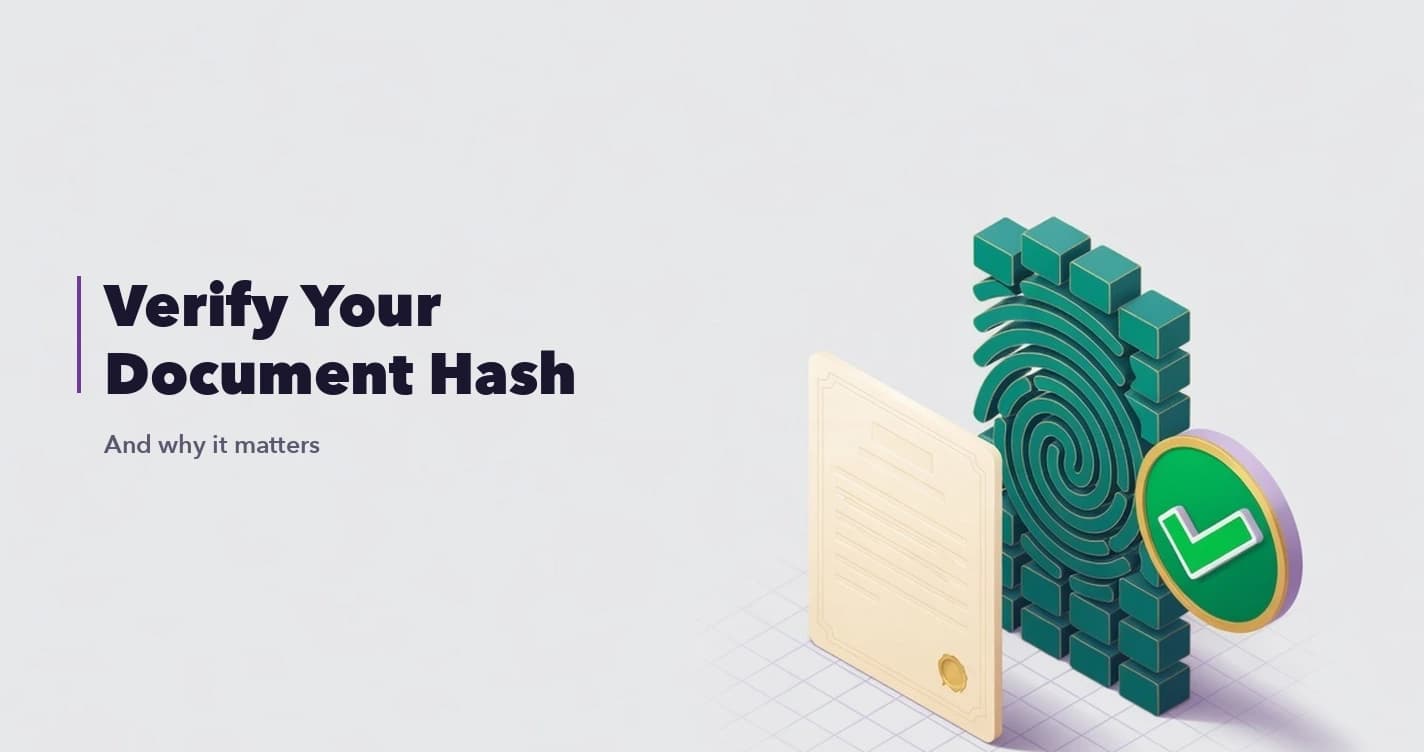
Think of a hash like a fingerprint for a document.
Every person has a fingerprint. No two people in the world share the same one. If a detective finds a fingerprint at a scene, they can match it back to the exact person it belongs to. Even identical twins have different fingerprints.
A document hash works the same way. A computer reads every single letter, number, comma, and space in your document. It turns all of that into one long string of letters and numbers. That string is the fingerprint of your document.
It looks like this:
9f3a7b21c8e0d4f6a2c91b8e7f3d5a0c2b9e8a7d6f5c4b3a2918073645f2e1d0
Sixty-four characters. That is your document's fingerprint. We call this a SHA-256 hash, but the name does not matter much. What matters is what it does.
Here is the magic part. If you change even one tiny thing in your document, the entire fingerprint changes. Add a comma? New fingerprint. Change a name from "Sarah" to "Sara"? Completely new fingerprint. Bump a percentage from 50% to 51%? The whole string of letters and numbers turns into something totally different.
This means a hash is the world's most sensitive lie detector for documents. If someone messes with your DigiWish, even by a single character, the new fingerprint will not match the old one. The change shows up instantly.
Why Just Storing the Hash Is Not Enough
So far, this sounds easy. Take your document. Make a fingerprint. Save the fingerprint somewhere. If anyone tampers with the document, you can spot it.
But there is a sneaky problem.
What if someone tampered with your document AND with the fingerprint at the same time? They change a name in your will, then they make a new fingerprint, and they swap that in too. Now the document and the fingerprint match each other again. The lie detector has been tricked.
To stop this, the fingerprint needs to live somewhere nobody can touch. Not even DigiWish. Not even the people who built the system. Not even a hacker who breaks into our servers.
That is where the blockchain comes in.
The Blockchain Is a Notebook Nobody Can Erase
You have probably heard the word blockchain before. People throw it around when they talk about Bitcoin or crypto. The idea sounds complicated, but the part that matters for DigiWish is actually simple.
A blockchain is like a giant notebook that millions of computers around the world keep a copy of. When you write something into this notebook, all the computers check it, and once they agree, the writing is locked in forever. Nobody can erase it. Nobody can change it. Not the computer that wrote it. Not the company that built the system. Not a thief. Not even a judge.
DigiWish uses a blockchain called Polygon. When your DigiWish document gets created, we calculate its fingerprint, and then we write that fingerprint into the Polygon notebook. From that moment on, your fingerprint is stuck there forever, watched by millions of computers, with no eraser anywhere on Earth.
We do not write your actual will into the blockchain. Your will stays private and locked on your device. We only write the fingerprint, the meaningless string of letters and numbers. The fingerprint by itself reveals nothing about what your will says. It just proves what your will looked like at a specific moment in time.
What "Anchoring" Means
When we put your fingerprint onto the blockchain, we use a fancy word for it. We call it anchoring your document.
The word fits. Imagine your document is a boat floating on a sea of time. Without anchoring, the boat can drift. Someone could come along, swap your boat for a different one, and you would never know. Anchoring drops a heavy chain from your boat down to the bottom of the sea. From that moment, the boat cannot drift. It is fixed in place. If anyone shows up later and tries to claim a different boat is yours, you can point to the anchor and prove it.
Once your DigiWish is anchored, three things are true forever.
First, the fingerprint is locked into the blockchain notebook with a date and time on it. We can prove that on this exact moment, your document looked exactly like this.
Second, anyone in the world can look up the fingerprint and check it. They do not have to trust DigiWish. They do not have to trust Polygon. The notebook is public.
Third, if even one tiny part of your DigiWish ever changes, the new fingerprint will not match the anchored one. The mismatch is the alarm bell. The lie detector has caught the change.
How You Verify Your Document Hash
This is the part that matters to you. Here is how you actually use this in DigiWish.
When you open your DigiWish dashboard, you will see a button called Hash Details. When you tap it, the system does something simple but powerful. It takes your DigiWish, right now, and calculates a fresh fingerprint. Then it goes to the blockchain and pulls the fingerprint that was anchored last. Then it compares the two.
There are two answers you might see.
If the fingerprints match, you see a green check. Verified. This means your DigiWish is exactly as it was the moment you anchored it. Not a single comma has changed. The math itself is telling you everything is fine.
If the fingerprints do not match, you see a different message. Modified. This means something has changed since the last time you anchored. Most of the time this happens because you yourself updated your DigiWish, which is normal. The system gently reminds you to anchor the new version so the latest fingerprint gets locked in.
You can also verify in a second way. If someone hands you a PDF or a Word file and says "this is your DigiWish," you do not have to trust them. You can upload that file into DigiWish, and the system will calculate the fingerprint of the uploaded file and compare it to the anchored fingerprints on the blockchain. If the file is real, the fingerprints will match. If the file has been changed in any way, even by one character, the fingerprints will not match, and you will know instantly that the document is fake or tampered with.
This is the whole superpower of hashing. You can prove a document is real without anyone needing to read it.
What the Verification Actually Tells You
When DigiWish gives you a green check, it is not just saying "looks fine to us." It is telling you something much stronger.
It is telling you that on a specific date and time, this exact document was anchored to a public blockchain that millions of independent computers agree on. The fingerprint we anchored that day is the same fingerprint your document gives today. Therefore, no part of this document has changed since that day. Not a number. Not a name. Not a comma.
This is not our promise. This is not our guarantee. This is math. And math does not lie.
You also get something called a Certificate of Immutability. This is a document you can save or share that shows the proof. It contains the transaction number on Polygon, the block number, the date and time, and a small square code you can scan with your phone to look up the proof yourself on the public blockchain. You can show this certificate to a lawyer, a family member, or a court, and any of them can independently verify that what you have is the real, unchanged DigiWish.
What If the Blockchain Goes Away?
This is a fair question. If we are trusting the Polygon blockchain to remember your fingerprint forever, what if Polygon stops existing one day?
Two answers help here.
First, blockchains do not just disappear. There are millions of computers running Polygon all around the world. They are owned by different companies, different people, in different countries. For Polygon to go away, almost all of those computers would have to shut down at the same time, which is about as likely as every bank in the world closing on the same day.
Second, your DigiWish does not depend on the blockchain to exist. The blockchain only exists to prove the fingerprint. Your actual will is encrypted on your device and inside DigiWish, safe and lockable just like any other document. The blockchain is the witness. Even if a witness disappears, the document does not.
Why This Matters for a Will
A will is not like other documents. A will only matters once, at the worst possible moment, when you are no longer around to confirm what you wrote.
That is the moment when family members start arguing. That is the moment when a cousin shows up with a "new copy" of the will. That is the moment when somebody quietly suggests that maybe one paragraph was added later, or maybe a name was changed, or maybe the percentages were not really what you said.
Without proof, these arguments can drag on for years. Lawyers get involved. Courts get involved. Families fall apart. Money gets locked up. And the worst part is, the person who could settle the argument with one sentence, you, is not there to do it.
Hashing and anchoring solve this. Your DigiWish has a fingerprint, anchored to a public blockchain on a specific date. Anyone can check it. Anyone can prove it. There is nothing to argue about, because the math has already settled the question. The will is the will, exactly as you wrote it, frozen in time the moment you anchored it.
This is why we built the verification feature. Not because hashing is cool. Not because blockchains are trendy. But because your family deserves to know, with absolute certainty, that what you wrote is what they read.
Frequently Asked Questions
What is a document hash?
A document hash is a unique fingerprint of a file. A computer reads every character of the document and turns it into a long string of letters and numbers. If even one character of the document changes, the entire hash changes. DigiWish uses a hash type called SHA-256, which produces a 64-character fingerprint that is practically impossible to fake.
Why does DigiWish use a blockchain?
We use the Polygon blockchain to lock in your document's fingerprint at a specific moment in time. Once a fingerprint is anchored on Polygon, no person or company, including DigiWish, can change it or erase it. This means you have permanent, public, mathematical proof that your DigiWish has not been tampered with.
Does DigiWish put my will on the blockchain?
No. We never put your actual will, names, account details, or instructions on the blockchain. We only put the fingerprint, which is a meaningless string of letters and numbers by itself. Your real will stays encrypted and private on your device. The blockchain just acts as a public witness that the fingerprint existed at a certain time.
How do I verify my DigiWish?
Open your DigiWish dashboard and click Hash Details. The system will calculate your DigiWish's current fingerprint, fetch the last fingerprint that was anchored to the blockchain, and compare them. If they match, your document is verified. If they do not, it means the document has changed since the last anchoring, and you can simply anchor the new version.
Can I verify a PDF or Word file someone sends me?
Yes. If someone hands you a file claiming it is your DigiWish, you can upload it into the verification tool. The system will calculate the file's fingerprint and check it against the fingerprints anchored to the blockchain. If the fingerprints match, the file is genuine. If they do not, the file has been changed, replaced, or faked.
What if my DigiWish hash does not match?
A mismatch usually just means you updated your DigiWish and forgot to anchor the new version. This is normal. You simply re-anchor your DigiWish to lock in the new fingerprint. A mismatch only becomes a real concern if you did not change anything yourself but the fingerprint is different anyway, which would point to a problem worth investigating.
What is anchoring?
Anchoring is the moment we record your document's fingerprint into the blockchain. Once anchored, the fingerprint is permanent and public. Anyone in the world can look it up, and nobody can change or erase it, including us. Each anchoring also gets a date, a time, and a transaction number you can use as proof.
What is a Certificate of Immutability?
A Certificate of Immutability is a document we generate after anchoring. It contains the proof of the anchoring, including the date, the transaction number, the block number on Polygon, and a small QR code that links directly to the public record on the blockchain. You can save it, share it with a lawyer, or show it to your family as evidence that your DigiWish is real and unchanged.
Can a hacker change my hash?
No. The hash is not stored only on our servers. It is stored on the Polygon blockchain, which is kept in sync by millions of independent computers worldwide. To change the hash, a hacker would need to take over a huge part of the entire blockchain at the same time, which has never been done and is not realistically possible.
Does verifying my hash cost anything?
Verifying is free. You can verify your DigiWish or check an uploaded file as many times as you like. Anchoring a new version of your DigiWish to the blockchain involves a small network fee, but the verification itself is just math comparing two fingerprints, which costs nothing.
What happens if I lose my Certificate of Immutability?
You can always generate a new one. The proof lives on the blockchain, not on the certificate. The certificate is just a friendly way to show the proof. You can come back to your DigiWish dashboard at any time and download a fresh certificate.
The Bottom Line
A will is only powerful if everyone believes it is real.
Without a fingerprint, a will is just a piece of paper or a digital file that anyone could claim was changed, faked, or replaced. Arguments happen. Trust breaks. Families fight.
With a fingerprint anchored on a public blockchain, none of that matters. Your DigiWish has a unique signature locked into a notebook that millions of computers protect, with a date and time stamped onto it forever. Anyone can check it. Anyone can prove it. Nobody can deny it.
The verification button in your dashboard is not just a feature. It is your DigiWish's own personal lie detector, available to you at any time, free, instant, and powered by math no human can override.
Your wishes deserve more than a promise. They deserve proof. And now they have it.