
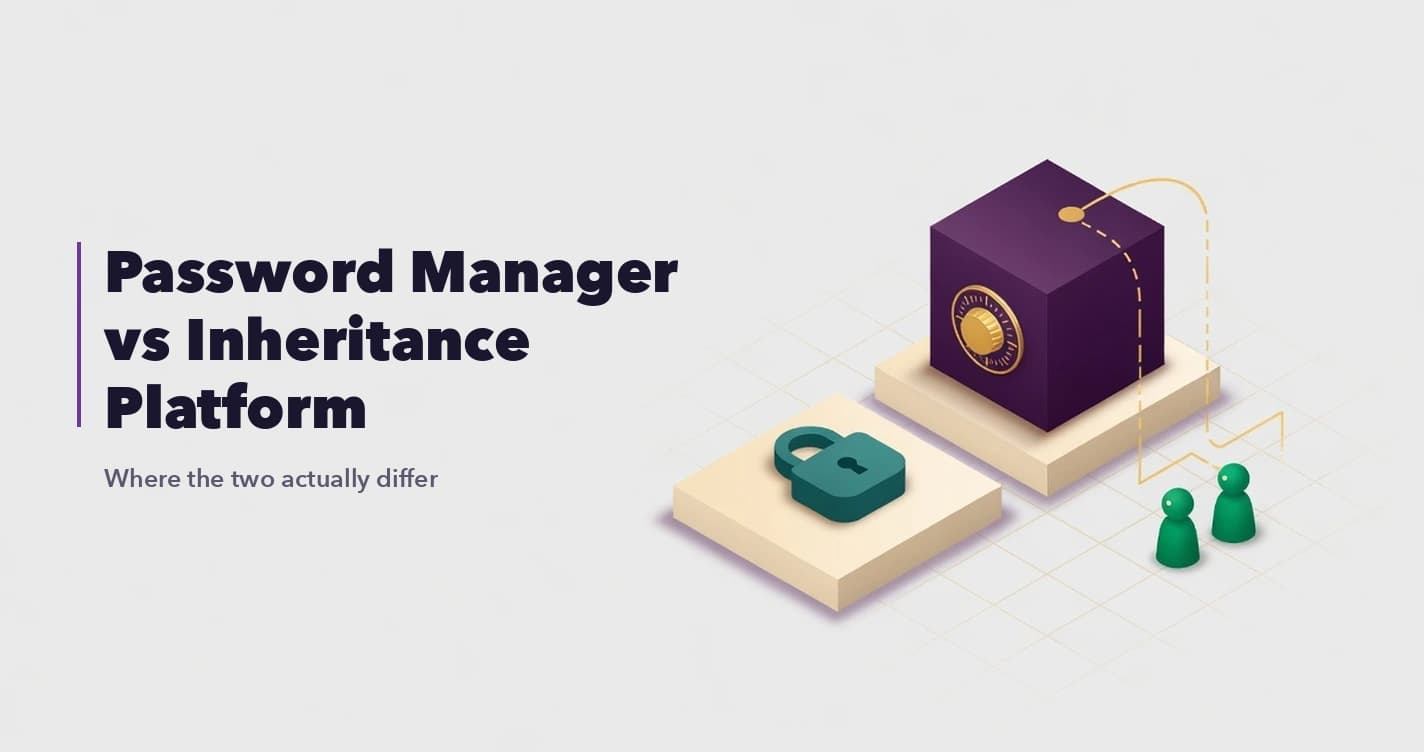
If you already use 1Password or Bitwarden, you might reasonably think you have your digital estate covered. Your passwords are in a vault, some of these tools even offer an "emergency access" feature, so surely your family can get in when they need to. The question of password manager vs digital inheritance platform sounds like it should have an obvious answer: aren't they the same thing?
They are not, and the difference is the entire reason BlockWill exists. A password manager is built to protect your secrets while you are alive and using it. A digital inheritance platform is built to make sure the right things reach the right people at the moment you no longer can. Those are different jobs, with different security models, different triggers, and very different consequences when they fail. This guide walks through exactly where they diverge.
The short answer
A password manager stores and protects credentials for your own daily use, with optional emergency access as a bolt-on. A digital inheritance platform is purpose-built for succession: it releases access only on a trigger and under conditions you set (such as a date you choose or an executor's confirmation), covers documents and wishes rather than just passwords, and is designed for a grieving beneficiary who may never have used the product before. If you want your family to reliably inherit your digital life, a password manager alone leaves critical gaps.
What a password manager is built for
A password manager solves a living-user problem. It generates strong, unique credentials, syncs them across your devices, autofills them, and keeps them encrypted behind one master secret. It is excellent at this, and everyone should use one.
The emergency-access features that tools like Bitwarden offer are genuinely useful, but they are designed as a safety net for account recovery, not as an inheritance system. They typically work by letting you nominate a trusted contact who can request access after a waiting period during which you can decline. The model assumes both parties are active users of the same product, that the recipient already has an account, and that a simple time delay is enough of a safeguard. That is fine for "I am locked out and need my partner to help," and thin for "I have died and my family needs to settle my estate."
What a digital inheritance platform is built for
A digital inheritance platform starts from the succession problem, not the daily-login problem. Its core question is not "how do I fill this password field" but "how do I make sure that, when I am gone, the specific people I choose can access exactly what I intended, verified properly, and not one moment too early."
That reframing changes everything underneath. At BlockWill, the platform is organized around a release process you configure rather than a single emergency-access request, around beneficiaries who may be first-time users arriving on the worst day of their lives, and around content that is far broader than passwords: legal documents, crypto wallet records, and your written wishes for each asset. It is estate infrastructure, and inheritance is the whole point rather than an add-on.
Feature matrix
- Primary purpose. Password Manager: protect your credentials while you are alive; Digital Inheritance Platform (BlockWill): deliver your digital estate to your family when you are gone.
- Release trigger. Password Manager: time-delayed emergency access request; Digital Inheritance Platform (BlockWill): a Dead Man Switch date you set, inactivity confirmed by an executor, or an identity-verified executor starting a release with a written justification.
- What it holds. Password Manager: passwords and secure notes; Digital Inheritance Platform (BlockWill): documents, crypto wallet records (where the seed phrase is kept, not the phrase), passwords, and written wishes for each asset.
- Recipient experience. Password Manager: assumes an existing account and product familiarity; Digital Inheritance Platform (BlockWill): designed for a grieving, first-time beneficiary.
- Guards against early release. Password Manager: a waiting period you can decline; Digital Inheritance Platform (BlockWill): inactivity alone releases nothing, executors must pass identity verification, and a cooldown of 3 days to 6 months that you or an executor can cancel.
- Provider access to contents. Password Manager: varies, and the provider may hold keys; Digital Inheritance Platform (BlockWill): vault contents are encrypted in your browser with AES-256-GCM, and the server stores only ciphertext.
- Legal and estate framing. Password Manager: none; Digital Inheritance Platform (BlockWill): executor, beneficiary, and guardian roles, plus audit logs.
- Wishes for each asset. Password Manager: not supported; Digital Inheritance Platform (BlockWill): DigiWish records who gets each asset by percentage, with written instructions (a record of wishes, not a legal will).
Emergency access vs inheritance: the key gap
The heart of the password manager vs digital inheritance platform question is the difference between emergency access and inheritance, and it comes down to three things.
The trigger. Emergency access usually relies on a countdown: your contact requests, you have some days to say no, then they get in. A death does not announce itself to a timer, and a countdown that fires on inactivity alone can release too early (you were simply on holiday) or force a family to wait out a clock during a crisis. A better inheritance flow does not let inactivity alone open anything. In BlockWill's VaultRelay, an executor has to confirm an inactivity release and signing in cancels it, an executor who starts a release must pass identity verification and write a justification, and these releases run a cooldown you set (3 days to 6 months) that you or an executor can cancel.
The scope. Your family does not just need your passwords. They need the trust deed, the insurance policy, the location of the hardware wallet, the instructions that make the passwords meaningful, and often the words you wanted them to have. A credential vault holds the logins. An inheritance platform holds the documents and context too, encrypted client-side in something like SecureVault, and records who gets each asset, with your written instructions, in DigiWish.
The recipient. Emergency access assumes the recipient is a competent, current user of the same tool. Inheritance has to assume the opposite: a grieving person, possibly non-technical, who has never opened the product before and is doing so under the hardest circumstances. That is a completely different design problem, which is why beneficiary onboarding is designed from scratch for that moment rather than reusing a normal signup.
Where they overlap, and how they work together
This is not an argument that password managers are bad. They are essential, and a digital inheritance platform does not replace one for daily use. Keep using your password manager to generate and autofill credentials every day.
The two are complementary. Think of the password manager as the tool for your living, logged-in life, and the inheritance platform as the layer built to make sure your estate, including but not limited to those credentials, actually reaches your family through a release process you control when the time comes. Many people will store a copy of their most critical access and documents in an inheritance platform precisely so that succession does not depend on a feature that was never designed for it.
Which one do you actually need?
If your only goal is stronger day-to-day security and the occasional "help me get back into my account," a password manager with emergency access is enough. If your goal is that your family can reliably and safely inherit your accounts, crypto, documents, and wishes when you die, you need a digital inheritance platform, ideally alongside your password manager. The two solve adjacent problems, and only one of them is actually about inheritance.
Frequently Asked Questions
What is the difference between a password manager and a digital inheritance platform?
A password manager protects your credentials for your own daily use, with optional emergency access as a safety net. A digital inheritance platform is purpose-built for succession: it releases access only on a trigger and under conditions you set, covers documents and wishes as well as passwords, and is designed for a first-time grieving beneficiary.
Isn't password manager emergency access, like Bitwarden's, the same as inheritance?
No. Emergency access is typically a time-delayed request designed for account recovery between active users of the same product. It does not check whether anything has actually happened beyond the waiting period, covers only what is in that password vault, and assumes the recipient is already a capable user of the tool.
Do I still need a password manager if I use a digital inheritance platform?
Yes. They solve adjacent problems. Keep your password manager for generating, syncing, and autofilling credentials every day. Use the inheritance platform to make sure that your broader digital estate reaches your family, through a release process you control, when you are gone.
What can a digital inheritance platform hold that a password manager cannot?
Beyond passwords, it holds legal documents, crypto wallet details such as where a seed phrase is stored, and your written wishes for each asset, along with the estate roles (executor, beneficiary, guardian) and audit logs that make an actual inheritance work.
How does a digital inheritance platform prevent access being released too early?
In BlockWill, inactivity alone releases nothing: an executor has to confirm it, and signing in cancels it. An executor who starts a release must pass identity verification and write a justification. Every release except a Dead Man Switch date you set runs a cooldown of 3 days to 6 months, during which you or an executor can cancel it.
Can BlockWill read my stored passwords or documents?
No. Vault files, asset details and allocations are encrypted in your browser with AES-256-GCM before upload, so BlockWill's servers hold only ciphertext of your vault contents. Some account data, such as the names and emails of the people you add, is encrypted on the server instead, and a will snapshot you choose to share with a legal partner can be read by that partner. Access is released to your chosen people only through the release process you configured.
Further reading: