
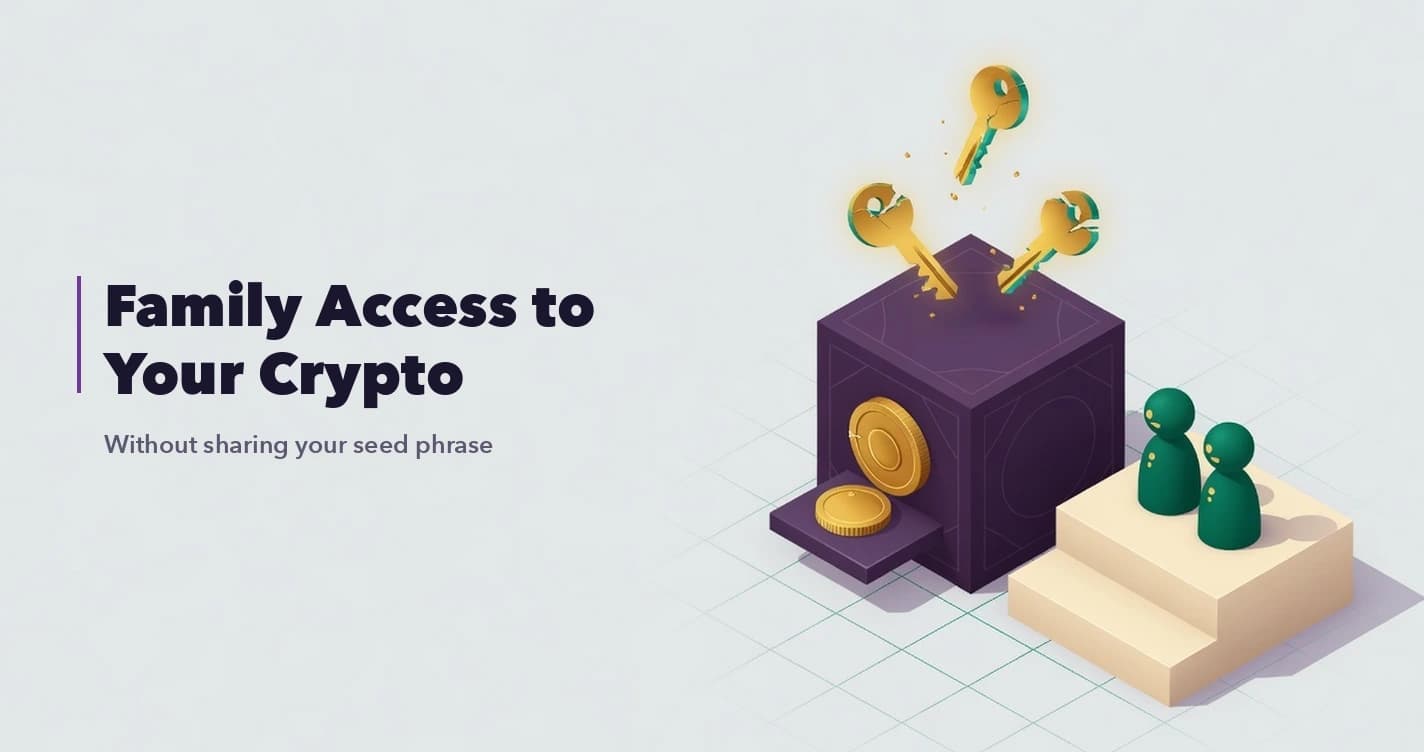
There is a specific, avoidable tragedy that plays out over and over in crypto. Someone accumulates real value in Bitcoin or other assets, they die, and their family knows the crypto exists but cannot reach it. The seed phrase was in the owner's head, or on a piece of paper no one can find, or on a hardware wallet with a PIN nobody knows. The money is right there on the blockchain, visible and permanent, and permanently out of reach. Making sure your family can access your crypto after death is one of the most important and most neglected parts of a modern estate.
The core problem is a gap between two things that feel like they should be the same but are not: legal ownership and technical access. This guide explains that gap and walks through how BlockWill closes it, so your heirs can inherit your crypto without you ever having to hand your seed phrase to anyone while you are alive.
The short answer
A will can legally assign your crypto to your heirs, but it cannot give them the private keys, and without the keys the crypto is unrecoverable. The safe solution is not to write your seed phrase down and hope, and not to hand it to a relative today. It is to keep an encrypted record of where your keys and seed backups are, and have it released to your chosen beneficiaries only through a release process you set up in advance. That is what BlockWill's vault and inheritance trigger are built to do.
Why a will is not enough
When you leave crypto in a will, you are recording your intent: this person should receive these assets. That is necessary, and you should still do it. But a will is a legal instrument, not a technical one. Probate can confirm that your heir is entitled to the Bitcoin. It cannot produce the private key that actually moves it.
Worse, putting a seed phrase or private key directly into a will is dangerous, because wills often become public documents through probate, and anyone who reads the phrase can drain the wallet instantly. So the will names the heir, and the keys have to be handled through a completely separate, secure channel. That separation is the whole design challenge.
Why the obvious workarounds fail
People reach for a few intuitive solutions, and each has a serious flaw.
Writing the seed phrase on paper and hiding it means a single point of failure. If it is lost, destroyed in a fire, or found by the wrong person, you lose everything or someone steals everything. Giving the seed phrase to a trusted family member today hands them full control of your assets right now, before you have died, which invites theft, coercion, or simple accident, and removes your ability to change your mind. Leaving it with a lawyer concentrates enormous risk in one party and one office. None of these verify that you have actually died before access is granted, and none of them protect you while you are still alive.
How BlockWill closes the gap
BlockWill treats crypto inheritance as two separate promises: keep your access completely private and under your control while you live, and release it to the right people only when a release you configured is triggered. Three mechanisms make that work.
Client-side encryption. Your sensitive access details, where your seed phrase backup is kept, wallet locations, and instructions, are encrypted on your own device before anything is uploaded, using the same approach described in the SecureVault walkthrough. BlockWill stores only encrypted data it cannot read. There is no plaintext copy of your keys sitting on a server.
Where, not what. The crypto wallet form asks where your seed phrase is stored and where the PIN is kept, not the phrase itself. Your family learns exactly where to look, and the phrase never has to be typed into BlockWill.
Release only on a trigger you set up. This is the part the paper-and-hope methods completely lack. BlockWill's VaultRelay starts a release in one of three ways: a Dead Man Switch date you choose, a period of inactivity that an executor then has to confirm, or an executor who has passed identity verification reporting your death or incapacity with a written justification. Inactivity alone releases nothing, and signing in cancels it. Apart from the Dead Man Switch date, every release runs a cooldown you configure, from 3 days to 6 months, and if it fires by mistake while you are alive, you or an executor can cancel it.
What your family actually experiences
When the time comes, your beneficiary does not have to be a crypto expert or a current BlockWill user. They are guided through a verification step and then given access to exactly what you left them, decrypted in their own browser, with instructions you prepared. We designed that arrival deliberately for a grieving, possibly non-technical person, as described in onboarding a beneficiary. The goal is that your family can follow a clear path to your crypto on the hardest day, instead of hitting a wall.
Set it up in the right order
The practical sequence is straightforward. Inventory your crypto holdings and where each one lives, wallets, exchanges, hardware devices. Record in your encrypted vault where each seed backup and PIN is kept, along with your instructions. Name your beneficiaries and configure your release conditions. And keep your legal will in sync, naming who inherits the assets while the vault records where the keys are. Done together, your intent and your access finally point at the same outcome.
The bottom line
Making sure your family can access your crypto after death comes down to closing the gap between owning it on paper and being able to move it in practice. You do not do that by trusting a single hidden secret or a single person. You do it by keeping an encrypted record of where your keys are, and releasing it only through a trigger you set up in advance. That way your crypto survives you and reaches the people you chose, which is the entire point of having it.
Frequently Asked Questions
Can I just leave my crypto in my will?
You should name who inherits it in your will, but a will alone is not enough. It records legal intent but cannot convey the private keys needed to actually access the crypto. Putting a seed phrase in a will is also dangerous, because wills can become public through probate.
Is it safe to give my seed phrase to a family member now?
No. Handing over your seed phrase today gives that person full control of your assets immediately, before you have died, which exposes you to theft, coercion, or accidental loss, and removes your ability to change your plans later.
How can my family access my crypto without me sharing my keys today?
By keeping an encrypted record of where your keys and seed backups are, instead of sharing the keys themselves, and having it released to your chosen beneficiaries only when a trigger you set up fires, such as a Dead Man Switch date or an executor-confirmed release.
What if a trigger fires while I am still alive?
Inactivity alone releases nothing in BlockWill: an executor has to confirm it, and signing in cancels it. Every release except a Dead Man Switch date runs a cooldown you configure (3 days to 6 months), during which you or an executor can cancel it. A Dead Man Switch date sends you email warnings 30, 7 and 1 days before it arrives.
Does my beneficiary need to understand crypto?
No. The inheritance flow is designed for a first-time, possibly non-technical user. Your beneficiary is guided through verification and given access to what you left, along with the instructions you prepared, without needing prior crypto expertise.
Further reading: