
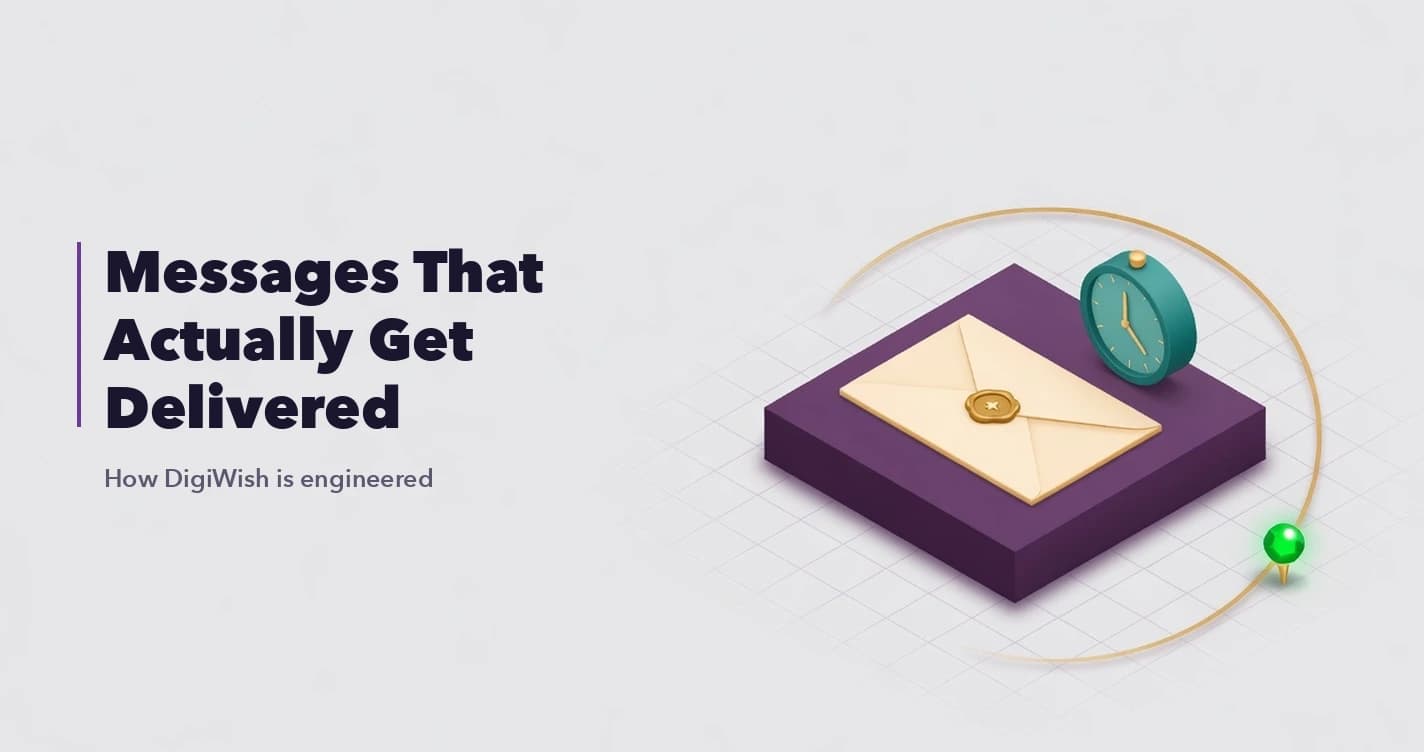
The idea of leaving a message for after you are gone is not new, and neither are the apps that promise to deliver one. The hard part was never the promise. It is the delivery. A time-released message is only meaningful if it actually reaches the right person, at the right moment, intact, and private until then. Plenty of services have offered the feature and quietly failed at one of those, delivering late, delivering to the wrong inbox, exposing the contents early, or disappearing before the message was ever sent. DigiWish is built specifically so that time-released messages after death actually get delivered.
This is a deep dive into how DigiWish handles the four things that make or break time-released delivery: privacy until release, the trigger, reaching the recipient, and surviving long enough to matter.
The short answer
DigiWish lets you write a message now and have it delivered later, either on a fixed date or when your death is verified. It keeps the message encrypted on your device until release so no one, including BlockWill, can read it early, ties delivery to a real trigger rather than a fragile timer alone, verifies the recipient before decrypting, and is backed by durable infrastructure so the message survives until its moment. Those four properties are what separate a message that gets delivered from one that merely got scheduled.
Privacy until the moment
The first requirement is that your words stay yours until the moment they are meant to be read. A message that a service can read, or that leaks early, is not a private final letter; it is a liability.
DigiWish encrypts each message on your own device before it is stored, using the same client-side approach as SecureVault. BlockWill holds only an encrypted blob and the delivery rule. We can see that a message exists and when it is scheduled; we cannot see what it says. The content is only decrypted in the verified recipient's browser at release. Privacy until the moment is not a policy promise, it is enforced by the encryption.
A trigger you can trust, not just a timer
Many failed "deliver after death" features rely on a naive timer: if the user goes quiet for a while, send the message. That is fragile in both directions. It can fire while you are simply on a long break, sending a death message prematurely, or it can fail to fire correctly at all.
DigiWish supports fixed calendar dates for messages meant for a known moment, like a future birthday, and for after-death delivery it ties release to the same verified event that governs your estate through VaultRelay. That means an actual confirmed trigger, with a cancelable window if something fires by mistake, rather than a lone countdown guessing at your status. The message goes out when it genuinely should.
Reaching the right recipient
Delivery is not just sending; it is sending to the right person and confirming it is them. DigiWish does not assume your recipient is already a user. When a message is released, the recipient receives a secure link and completes a lightweight verification, a one-time code to a known contact method, before the message decrypts for them and them only.
That verification matters twice over: it protects a private message from being opened by the wrong person, and it means you can leave a message for someone who has never touched BlockWill, which is most people you would want to write to.
Surviving long enough to matter
The quietly hardest requirement is longevity. A message meant for after your death might need to wait years or decades. That demands durable, redundant infrastructure, the kind of encrypted, multi-region storage and continuity planning that keeps data intact across a long horizon. A message that was perfectly scheduled but lost to a service shutting down or a storage failure is a message that was never really delivered. DigiWish is built on the same durable foundations as the rest of BlockWill's vault so that the wait does not become the point of failure.
Designed with restraint
Because DigiWish touches grief, the experience is deliberately quiet. There are no engagement nudges to write more, no gamification, no marketing wrapped around a final letter. When a message is delivered, the recipient sees your name and a short, human explanation first, not a product pitch. The delivery is clean and unmistakably from you. That restraint is part of what "actually gets delivered" means: delivered in a way that honors the moment.
The bottom line
Time-released messages after death are easy to promise and hard to deliver. DigiWish focuses on the four things that actually determine whether a message arrives: it stays encrypted and private until release, it fires on a verified trigger instead of a fragile timer, it verifies the right recipient before decrypting, and it is built to survive the long wait. That is the difference between a message you scheduled and a message your family actually receives.
Frequently Asked Questions
What is DigiWish?
DigiWish is BlockWill's time-released messaging feature. You write a message now and choose when it is delivered, either on a fixed date or when your death is verified. The message is encrypted on your device until the moment it is released.
How do I know the message will actually be delivered?
DigiWish is built around the four things that determine delivery: encryption that keeps the message private until release, a verified trigger rather than a lone timer, recipient verification before decrypting, and durable, redundant infrastructure so the message survives until its moment.
Can BlockWill read my message before it is delivered?
No. Each message is encrypted on your device before storage. BlockWill holds only an encrypted blob and the delivery rule, and the content is decrypted only in the verified recipient's browser at release.
What triggers a message to be sent?
Either a fixed calendar date you choose, or, for after-death delivery, a confirmed triggering event through VaultRelay. After-death delivery uses a verified event with a cancelable window rather than a simple inactivity countdown.
Does my recipient need a BlockWill account?
No. When a message is released, the recipient gets a secure link and verifies their identity with a one-time code before it decrypts, so you can leave a message for someone who has never used BlockWill.
Further reading: